A wild slim alien


4 Comments

Stepping out of character

Naturally, I assumed that as the book progressed, this plan would change, because books always end up taking on a life of their own, and because a person doesn’t write about what he wants to write about but what he’s capable of writing about.  I also assumed that, although everything I’d found out about Sánchez Mazas over time was going to form the nucleus of my book, which would allow me to feel secure, a moment would arrive when I’d have to dispense with those training wheels, because – if what he writes about is going to have real interest – a writer never writes about what he knows, but precisely about what he does not know. – Javier Cercas, Soldiers of Salamis

I often used to feel the same disgruntlement as Arthur Seaton.  ‘Whatever people say I am, that’s what I’m not.’  But at the same time I always knew that such contrariness ultimately ties its speaker or believer in knots; it certainly locked me into as inescapable a conundrum as the kindred contradiction of having once aligned myself so fervently with the song ‘I’m not like everybody else’.

Recently here I have been stepping out of character, because the alien found he wanted to be human, at least for a time.  But even as I have been doing so, I’ve felt the contrary pull: the human wants to go back to being a bloody-minded alien.  You’d think it might be different after all these years on earth, but it’s still the same.  Only now it’s getting confusing.  If I step out of the character of the human pretending to be an alien, only to assume another, that of the human-pretending-to-be-an-alien-become-human-again, then am I in character or out of it?

Like Midas’ fingers turned all he touched to gold (though perhaps without such dire consequences), I transform so much of what I see and feel into words.  I don’t think I can help it any more than he could, though often I wonder whether I have the means of expression to describe the places – mental and physical – in which I find myself.  I suppose that has always informed my writing, been the impulse for it, the not knowing rather than the knowing.  Needing to use words to work out what I think and feel beyond what I (think I) know I think and feel; to translate the peripheries of thought and the edges of emotion into language.  But however pioneering this settling of wild interior landscape may seem to me, sometimes simple expression is not enough.  There are times when I can’t find the words I need to fix myself, to find rest or peace, but need to, to scratch a particularly persistent itch, to stop myself falling down a deep black hole.  To keep myself away from those holes, if not the itches.

And so I have been wondering again, do I have to stop making sense to start making it, like Ben Marcus in The age of wire and string and thousands of bloggers with elliptical tendencies since?  I’ve never been inclined to think so, and I’m still not sure I do, but more than occasionally I feel the need to try.  To rap my fingers against my skull and start in on breaking up coherence, the long-established patterns of thought, and find what if anything is underneath.  Stir the sediment into a muddy maelstrom, record its chaos, watch how it settles, reflect on it.  Quantify and qualify the changes, if any.  I find I want to do that much more deliberately, with less concern for shareable clarity, and more for the suggestive power of language.

Well, I think I want to, anyway.  I may change my mind tomorrow.  And whatever people say I am, that’s probably what I was, yesterday.

Still from Saturday night and Sunday morning via not _ going.


4 Comments

The talent code

Glitter ball

He is quite shockingly confident, and I instantly dislike him as a result.  A quiet confidence I can warm to, but an unquiet one… well, it’s always been this way.  But then I have to remind myself that I started off life as a boy bursting with something of the same sense of entitlement, the same underscored security.

We’re at a hotel complex.  Not just a hotel, but a hotel complex.  The complex part takes from it any charm it might once have had in the days before it became a complex.  You may be asking, just how complex?  Well, complex enough to have its own Starbucks even though it is buried in the countryside miles from anywhere.  It’s dark, so I can’t see the full range of its complexity, but I suspect that as well as the conference space and eighteen hole golf course, there may be boutique shops including one selling cut glass, while lying in wait for uncritical visitors to the spa side of things, there is almost certainly a reflexologist.

The Champagne Bar is a collision of styles, an impressively unholy mess.  It’s as if they’ve asked four interior designers to go to work, and decided to use all four schemes.  Strip away any three and the result might just possibly have been tasteful.  Instead chandeliers rescued from Captain Nemo’s Nautilus compete with heads of Hindu gods, and a garish painting of Margaret Thatcher goes head to head with the biggest glitter ball under which it has ever been my nervous pleasure to stand.

It’s a celebration, and the shockingly confident young man has taken it upon himself to perform a handful of songs for the woman who stands a fair chance of one day becoming his mother-in-law.  He sings ‘Crazy little thing called love’ and a number by one of the more successful talent show graduates.  It transpires that he is the scion of this empire, heir to the complex, just as I was heir to a place which might in time have become such a complex, quite possibly under my guidance and in the image of my own crass, undeveloped taste.  What a very different life it would have been.  But however it turned out, I can’t quite see myself having performed Queen numbers to my future mother-in-law along the way.

In among the usual conversations about aliens, dead animals and football, a friend tells me about The talent code.  The book’s author says that ‘“Natural talent” is code for “started earlier and practiced harder”’, and that whatever the discipline, anyone can build fast, fluent skill circuits – axons in the brain sheathed in an insulating substance called myelin – through constant repetition of key movements.  I get it, I said – like Malcolm Gladwell’s 10,000 hour rule, only with physiological or neuroscientific icing on top.  While my friend and I are sure that our confident young man is even now seeking his moment in the talent show spotlight, neither of us needs to be Simon Cowell to determine that he hasn’t yet sung for 10,000 hours or sufficiently built up his myelin sheath.  (Note to self: who are you to talk?  You need to post more regularly – your writing axons must be in serious danger of losing what little myelin they had around them in the first place.)

Late that night, as I lie awake unable to sleep, my retinas still dazzled as they are by afterimages of light from the glitter ball, I think about my own levels of confidence, and such as it was, the talent I had.  Aged twelve my knees went from too much repetition of the key movements in my chosen discipline, coincidentally just as my confidence was being destroyed by a terrible but common family experience.  Perhaps underneath the early cocksure belief, I always had that degree of sensitivity, of brittleness which meant that whenever bad experience finally came along, it was going to turn me inwards, especially with the recourse to physical release also gone.  Inside I found what seemed to be my true self, and there I stayed, in that state of dreamy inwardness.  Life since has often felt like an ongoing battle to emerge from my shell and regain or retain confidence, with ever-varying degrees of success.  Over the years I have trained myself to be able to snap out of my introversion as and when I need to.  As for confidence, I rise above the moments of its lack and pass through them so much more easily than I did.  I suppose I have become comfortable in my head, if never quite in my skin.  Or is it the other way round?


7 Comments

Sedate pudgy aliens

Having accomplished our errand, my daughter and I went to the nearby toyshop to acquire yet another alien.

These are not aliens like me.  These extraterrestrials are squidgy, rubbery, unnaturally coloured foetal babies with oversize foreheads and undersize limbs which typically come in eggs and covered in goo, though the eggs of some have a coating of bicarbonate of soda or similiar which dissolves when you put it in lukewarm water, so allowing you to ‘birth’ your alien.  They are my daughter’s latest favourite thing.   It makes me think she is so much her alien father’s child.  She named some after the planets but now she has used up the solar system, the names are becoming rather more random – Clockbutton for a small green and Rendigo for a large silver one.  Drawing on the fiction that populates these pages, I keep suggesting Skudun, Badezon, Slessi and Cintilar – but quite reasonably these fanciful-sounding names are consistently pooh-poohed.

We left the shop with the latest additions to the ever-extending alien family, and had immediately to cross a busy road.  My daughter held my hand and on the other side not only kept it held but started skipping too.  I felt and thought, treasure this moment, because – since she is growing up so fast – it just might be the last time ever that she holds your hand and skips happily down a street like this with you.

Children do this bittersweet thing to parents on a daily basis – touch your heart while simultaneously prompting you to mourn the fleeting nature of such joys.  But even in this, there is continuity.  Something new always comes along to make your heart sing, to make you wipe away a discreetly shed tear.

(This is the kind of post I swore I’d never write – parent gushing about child – but well, even aliens have children, and its alien content lets me off the hook, doesn’t it?)


Leave a comment

He shoots, he misses

Up until a couple of years ago, I played five-a-side football every week with a group of friends, the core of whom worked for the same employer. Because the founders (and I) used to work in a building near Farringdon station, one of them had the bright idea that we should be called… the Farringdon Studs.  Or, as a female colleague of mine was moved to nickname us, the Farringdon Spuds, on account of that being a better representation of the average body shape we sported.

Playing football once or twice a week is a vent for folk who spend their days in offices. It becomes addictive, a moment of time during the week when you can lose your mind in something predominantly physical and instinctive. It’s fun, but don’t let anyone kid you that it’s non-competitive. Each week, with familiarity, with new blood, with would-be managers and captains watching your every pass, the pressure builds. It’s fun, but no-one wants to be on the losing team. So much so that inevitably there were dust-ups from time to time; but we always shook hands. You always should.

Five-a-side football has a place in British and I imagine European culture roughly equivalent to basketball in the States. At least, that’s what I think when I read George P. Pelecanos, and his characters are facing off on a neighbourhood court with two hoops. Those hoops, our goals, they carry in their nets echoes of the glory that as children and sometimes even as teenagers we thought might be ours. And for an hour a week, there is always the chance that glory will be ours again.

People play football according to their character. I suspect the differences are considerably more obvious than they are at professional level, where the standard irons out quirks, and media training dampens down personality. I played with some of the Studs for approaching ten years, and socialised with them enough to know that how they played on a five-a-side pitch was more or less how they were in the rest of their lives. You might even say that on the astroturf you see a more intense and honest version of the person, because what is said and done is rarely weighed beforehand.

So let me sketch a few of those characters. Sly Tom, the lazy fuck who lets others do his running, though you might call that positional sense, because he is a hard tackler and difficult opponent; of course he fancies himself (the long flowing locks and Terry Thomas moustache are a giveaway) but is still infuriatingly likable for all that. Dour and mischievous Sanjeev (traits that I always suspected came from being Rochdale born and bred), affects to be lazy but gets on people’s back when he believes they’re not pulling their weight and is himself capable of surprisingly hard work and unexpected flashes of brilliance. Farhan, who’s let himself inflate to a size he shouldn’t have, full of Brazilian trickery and amusement, but an organiser and as loyal as they come. Archie, rugby player build, and a mind that I imagine accords with the better parts of a rugby player’s too, something of a leader, never a lost cause, but gentle and generous immediately off the pitch. Dave, tenacious tackler, sticks to the left wing, cannonball shot, occasionally flaring temper, but more gracious than a long-standing freelancer has any right to be. Jimmy, whose centre of gravity seems to be lower than you’d guess, leaving him able to weave defences inside out before ramming the ball – previously stuck to his mercurial toes – home. Grumbling Wayne, consummately our best player, frustrated at everyone else’s inadequacies, but not apparently aware that he has any himself; by the end of the game disenchanted, talking to himself, quick to quit the scene.

Hadji

They would all recognise the others, if not themselves, in these descriptions, even with the names changed to protect the guilty. And me? Number 7 shirt, good passer of the ball, determined runner, reluctant but never less than positive captain. On the other side of the balance sheet, dodgy shot in front of goal, the tackling ability of Paul Scholes (translation: not good verging on dangerous), and prone to lapses of concentration. As is the lot of most players, it has been my destiny to know only occasional moments of glory; nothing has joined the MHFA (London) Five-a-side Winners 2001 trophy on the mantelpiece. It’s been downhill ever since.

I could offer the same kind of sketch for the Rovers with whom I risk my dodgy ankles on Regent’s Park’s baked and uneven surface come summer; or for any of the people with whom I’ve regularly played. Everyone has had something to offer on the pitch. Now I’ve found myself a new game, and the characters are all taking their place alongside all the other great and not-so-great five-a-siders I have known. My new team-mates might each remind me of certain of the Studs or Rovers, but in the final analysis – the one which is occasionally conducted in the pub after the game – every single one of them brings an identity onto the pitch as individual as his own face. And that is a vital part of what makes our weekly game so endlessly enthralling.


4 Comments

I am a tree – Scots pine

Scots pine

The trees along the wayside begin to stretch out now.  And they are closer to me; perhaps they are less easily defined because of that.   So we have to jump forward in time, through a decade which was far from treeless – among others London is full of its namesake trees, the planes, after all – but in which I formed no strong emotional attachments to any particular tree; or rather, can project no strong emotional story onto a sufficiently representative tree.  Of course, if I put my mind to it, there might be buried deep in me trees which had some passing significance, a Japanese maple here, an oak there.  But for a long time I lived without the special trees that seemed to dot my childhood and teenage years.

True, for half that decade there was by the gate of my house an old lilac, which though gnarled, still flowered fresh and white every year – but again, I would be pushing the limits of my metaphor to associate myself with it, or the pair of leylandii out the back which formed such an effective screen of green, and out of which one day the head of my brother (a tree surgeon) popped as he topped the cypresses to inhibit their monstrous growth.  You don’t see him at first when you look at the photograph.  And then you smile.

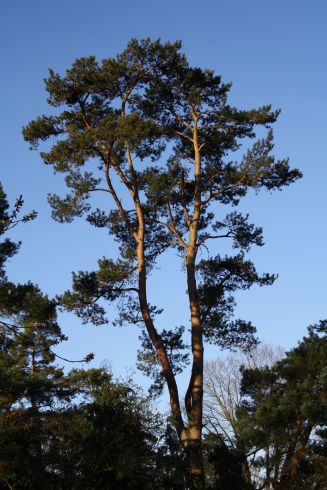
So we jump forward another half decade, to a house not quite in the countryside, but a place where suburban dreaming is at least well hidden among the loft of pines and the easy elegance of sweet chestnuts.  And perhaps it is just because it is my current tree, and it too will fade to take its place among the others, but I seem never to have so readily identified with a tree as this one.  It stands with others, but a little apart, a little proud.  It’s slim, alien, a tree in exile, one both hardy yet supple enough still to bend in the wildest wind, to stand up to its force.  On sunny blue sky days and frozen winter ones it is even gifted a certain grace.  Its trunk divides neatly in two but in its crown branches and needles of the two forks intertwine and come together.  A split personality or a unity, it’s hard to say.  It drops cone after cone.

Threatened with and saved from the axe two years ago, now it’s under threat again.  To me it is a beautiful tree, to someone else an inconvenience.  I’m trying not to take it personally, but I don’t think it wants to be made into furniture any more than I do.

Photo by awildslimalien.  See the Scots pine in winter.

Listen to the song that was a small part of the inspiration for this series – Guided By Voices’ ‘I am a tree’.


Leave a comment

I am a Christmas tree – Norway Spruce

Norway spruce

It was the year before the Christmas I spent at a friend’s, away from what for a time was a non-existent home.

The village was called Thorpe Morieux, which pronounced in Suffolk dialect comes out as M’roo.  We were living in a rented cottage.  ‘We’ meaning the four of us, my father having recently left to move in with the woman who, on account of her long black hair and no doubt her powers of seduction, my mother habitually called the Witch.  There were nights when mum was so distraught and maddened with jealousy that she packed us and sleeping bags into the Mini, and drove around for hours, trying to track dad down, not yet knowing where he lived with the Witch.  A couple of nights we even slept in the car despite the winter cold, warmed only by the bags and occasional running of the engine and heater.  On other nights, when dad had visited to see us and argue with her, she would place herself in front of his Datsun as he tried to drive away.  We would stand shivering just inside the gate, petrified by the combination of dad revving the engine of the Witch’s Datsun and mum screaming.  And then we’d all jump in the Mini and set off in low-speed pursuit.

Inevitably in the run-up to Christmas Day my mother’s mind was elsewhere.  By Christmas Eve, there were no decorations, no signs of anything to do with Christmas beyond a few cards on the mantelpiece.  Nor was there a tree; it really looked like Christmas was not going to happen.  As in The lion, the witch and the wardrobe, it seemed it would be ‘always winter, and never Christmas.’

Dad came that afternoon and the arguments raged into the evening as usual.  From the landing we listened to their fluctuating flow, raised and heated voices one moment, reasonable and difficult to discern the next.  After a time we went to bed, expecting nothing of the next day, and not caring very much about that.  We wished only for peace between them, for the barely remembered order of what seemed like long ago to be restored.  I’m not sure we even bothered hanging up stockings.

But in the morning there they were bulging at the foot of each of our beds.  Downstairs cards were hung on strings, and last year’s pastel-coloured paper chains looped from spot to spot suspended from the ceiling.  Best of all – and to see it was one of the most magical moments of my childhood – there was a properly dressed tree with a small mountain of presents under it.  Somehow the warring factions had pulled themselves together enough to rescue the day for their children.  My brother and I tore off the paper on a Subbuteo set, the World Cup edition, complete with scoreboard, floodlights and a plastic replica of the Jules Rimet trophy.  After lunch, a proper Christmas one, eaten in harmony, Brazil took on West Germany, and beat them 4-2, despite the South Americans being forced to play with only ten men for a large part of the game, my brother having broken one of their legs under his clumsy knee.

In an unconscious recreation of Christmas 1914 – peace and football in the no man’s land between the trenches – my mother and father managed to call a truce for the day, and it held at least until we went to bed again, although that may be because dad simply disappeared after lunch; he is gone from my memory of the evening.  But because it had really seemed that there would be no Christmas, in the end it felt like one of the best.

Photo of Norway spruce by Philip Halling via Geograph.


Leave a comment

I am a tree – Weeping willow

Weeping willow

The end of a close, a cul-de-sac.  A dead end in a dead end town.  I wanted to be with her but I didn’t want to be there.  But then neither did she.

The room in which I wrote and studied was bare-boarded and empty.  Temporary.  We didn’t sand it down or carpet it because we never intended to be there long.  The pale green pile of the living room carpet held the smell of the previous owners’ dogs.  We should have made the effort to get rid of that.

The empty room looked out over the garden, and Tricky’s beats and Chet Baker’s voice and trumpet sounded fine in it.  Beyond the garden were waterlands.  Fishing lakes man-made out of the marshes of the Blackwater valley.  The river itself ran along the bottom of the garden.  A weeping willow wept into it, especially lachrymose since diggers and all manner of other heavy vehicles had moved in to build a ‘relief’ road through all that watery quiet and beauty.  But by the time I got there it was long past the moment to throw myself in front of the diggers.  The battle had been lost years before.

Though she had been there longer, it was my home only for a year.  Our first together, so that it didn’t matter so much that we weren’t in the perfect place.  Neither were the neighbours perfect.  On one side, a couple with a young family, the intemperateness of the father audibly being reproduced in the son.  By which I mean shouting.  Lots of it, through the walls.  Constant running battles between all members of a nuclear family; a war of attrition.  Sometimes, scarily thuggish-sounding behaviour, the kind where you wonder whether you should be calling in help.  On the other side, the relatively comic character of Rod, constantly tinkering under a bonnet and giving the distinct impression that the garage out of which he worked was a lock-up for goods not of entirely legitimate sourcing.

On cold and dark winter mornings I would cycle the fifteen minutes to the railway station, up the hill through the cemetery and then down past the football ground.  And so began my first suburban commute among pinstripes and pencil skirts.  But in taking that regular train I restored my connection with London.  I could feel the Smoke calling me back; I’d been away long enough.  I still wanted, I think, its ache of possibility.  The good in that, and the not so good.  The magic, when you were out, of seeming to be at the centre of the world; and the other edge of that feeling, that if you stayed home, life was passing you by.

And yet, even there in a place that was far from being London or France or Bristol, there was magic if and when you looked for it.  At the weekend the diggers were silent and but for odd pyramids of gravel and sand you could imagine nothing had changed.  Skeins of geese flew in and out of the watery landing strip; in her company or alone I walked the banked-up towpath in one direction or another, accessing the canal where now it bridges the relief road as an aqueduct.  I watched narrowboats pass, and wondered what it would be like to live life at that pace, not needing to be anywhere special at any time; idly making for the Wey navigation, and then on to explore the upper course of the Thames, with all the time in the world at your disposal.

In the garden, from a deck chair, you could lose yourself in watching the little river slowly flow; and, reflected in its glassy water, the weeping trails of the willow’s golden shoots.

Photo by agaetys via deviantART.


Leave a comment

I am a tree – Copper beech

Copper beech

The house was in Redland, at the junction of Ravenswood Road and Woodstock Avenue.  It was built solely in creamy Bath stone and couldn’t help being rather more elegant than the other houses on the street, which like so many buildings in Bristol combined Bath stone quoins with a facing of light red Pennant.  On the corner of the plot where the streets met stood a huge copper beech tree, its branches bare, it being the dead of winter.  But you could tell it would be magnificent come spring.

Our love depended on the telling of a lie – a little white one – to enable me to get a place to live on returning from France.  I had decided to give Bristol a go, it being where a bunch of friends lived.  The landlord of the bedsit I liked required me to be working, which I wasn’t yet.  Drawing on my London Underground experience, I pretended I worked for British Rail up at Temple Meads, Bristol’s fairy tale train station.  With the help of my friends, I may even have faked a letter to prove it.  I’m not sure the landlord was entirely convinced, but even though he worked in insurance, he allowed himself to buy it and take the month in advance.

I met her for the first time on the day I moved in.  My friends had all come over to check out my new place, and were piling out the door – Monkees monkeying around – as she reached the landing on to which it opened.  I can still remember what she was wearing.  A red jumper with a wide neck and patterned lilac leggings.  She was beautiful, with full lips and lots of golden brown hair and pinked and shapely cheeks.  One friend after meeting her for the first time said that I’d found a real English rose but by blood she was three-quarters Irish.  You could see that in her smiling eyes.  We shook hands (having come back from France, I shook hands left, right and centre) and exchanged a few words.  I expect I apologised for my friends.  She had the ground floor room, whose light was filtered through its bay window by the beech’s canopy; brighter in winter and dark in summer.  Her appearance there on the landing convinced me that I had chosen the right place to live.

But we took a winding path into love, the relationship not even hinting at beginning until after she had moved out, seven months later.  On a summer’s day she returned on an antiquated bicycle to pick up mail and came into my room for the very first time to drink some water.  She had on a flowery summer dress and settled into my flowery red armchair while I sat facing her, and through the thick warmth of the air, with the reddish-purple leaves of the beech visible outside the two open sash windows, I think we could both tell that something was starting.  We arranged to meet the following week, at a pub up by the Downs.  Of course, her boyfriend would be there too.

I don’t think I was quite myself that night at the Port of Call.  I was merciless in my mockery of him.  It was easy, he was a Liberal Democrat.  She laughed a lot.  He hid any gall well.  That summer, having finished a thesis which combined readings of Shakespeare and Austen, she polished off all of Das Kapital.  She remains the only person I know who has read the entirety of its three hefty volumes.

I made them (her) a tape.  I called it ‘Heard through a wall’, after a Del Amitri tune.  It was half-filled with love songs.  The message must have been unmistakeable, to both of them.

But suddenly she was no longer in Bristol, having got a job in a place a hundred miles to the east.  She invited me to stay, even while she was nominally still with the Liberal Democrat.  Mortifyingly during the visit my false front tooth fell out and if I smiled you could see the spike to which it was usually fixed.  And still she wasn’t put off.  In the night, in the dark, having resisted all temptation, she got out of her bed and came and sat on mine, and stroked my hair.

And then, back in Bristol after visiting the Liberal Democrat for the weekend, she dropped in on me with flowers but found me having a fish and chip and curry sauce supper with my sister and her boyfriend and wouldn’t join us.  But it was ending between them.  The next time she came back to the house in which she used to live, in the lee of the copper beech whose branches were once again bare, it was to stay the night.

Photo of Ravenswood Road, Bristol by awildslimalien.


Leave a comment

I am a tree – Apple

The magic apple tree

‘From the wet grass beneath the largest tree, on a misty, drizzling day, you help collect the hardy red bite-sized cider apples, letting the handfuls fall into a metal bucket placed equidistant between you and Monsieur Drouet.  The maggoty, the decayed, and the ones dabbed in sheep shit are all democratically added to the cider electorate.  Leaves clinging to the fruits are enfranchised too.’

I’ve already written about the apple trees.  They became part of the fictional landscaping of six months living alone in a storm-damaged thatched cottage in Normandy.  I called it Kerplunk! because it sometimes felt like I was slowly losing my marbles, both in the living and in the subsequent writing.  The trees and the sheep which grazed under them were my constant companions.  They weren’t so old, the trees, but neither were they saplings, like I felt I was.  Already they had gone a little gnarled, angling themselves so as to turn the other cheek from the wind.  Perhaps I was more like them than I realised, though I certainly wasn’t going to let sheep munch at my fruit.

While in Normandy I wrote letter after letter, so desperate was I for contact, for a return on that letter-writing investment.  Why then did I effectively isolate myself for so long?  Because I wanted to work out who I was, and I thought the best way to do so was to be apart from all that I had known and all that had influenced me.  And because I wanted to be a writer, and I knew that to write, more than anything else you must find time alone.  Of course, I took that to the extreme, being the person I was.  Am.  Those letters, what I wrote in notebooks, what would become a first novel; that was the start of what I continue to do here, and elsewhere.  To work out who I am and what I think through the written word.  Back then I was both naïve and arrogant enough to assume that what I made of myself would be of interest to others.  All that’s left of that notion now is a ghostly remnant, but the urge to turn life into art is still as strong as it ever was.  And while it doesn’t matter whether or not anyone reads these words or any of the others I write, I still care what those who do take the trouble to read them think, and it may be this that makes me draft and redraft compulsively as much as my need to get to the heart of what I am writing about.

How did the fictional telling of that time in Normandy differ from reality?  Not so very much.  My character was not a writer but a photographer.  The plot was a woman, or rather two women, one left behind and one encountered in France.  In reality there were three women left behind and none found in France (which of course says much more about me than it does about French women).  One of the three might have come, was persuaded to, but for very good reasons didn’t.  And so on the surface of reality, not a lot happened, for all of my travels around France.  But on the inside…

In the last third of Kerplunk! I grappled with the effect that depression has on love, or potential love at least.  You won’t be surprised to hear that there was no happy ending.  But then neither in the end was the ending sad.  It was just an ending, pointing to another beginning.

In one of the letters I wrote – possibly in several, to a handful of recipients including those three women – I declared that I didn’t want these six months to become an island of time, one green emerald in a sea of blue.  Perhaps I should have kept travelling, stayed away longer.  But not for the first time and certainly not the last, I felt tugged and torn in two different directions.  Waiting for me with outstretched arms was home and warmth and contact and touch, the pleasures of the familiar.  Against that temptation stood being abroad and alone and seemingly always on the edge of life, in both the bad sense and the good; peripheral but every day something new.  I guess ultimately I chose the comforts of home.  And that time in France remains an emerald in a sea of blue.

But I stayed a writer, and I carry those apple trees within me still.  Cider apple trees, from which Calvados was also made.  It’s obviously a particular taste, by no means for everyone, but a snifter of my apple brandy will tell you that it’s nicely matured now.  And it turns out that those sheep with whom I shared time and space have been munching away at my fruit all these years after all.

The magic apple tree by Samuel Palmer via Wikipedia.


Leave a comment

I am a tree – Rowan

Rowan

London!
The way you hate me is better than love
and I’m head over heels
London!
The way you wanna get rid of me
makes me weak in the knees

I can see them now, the rowan berries, outside the window, the last of them hanging from the branches of the tallest of their kind that I’ve come across.  The stairs round the back of the house are a carpet of red, with berries pulped by our feet on each step.

Back then they hung from much smaller trees, perhaps less than ten years old, an early attempt at greening a nondescript residential street in Holloway, north London.  And I wonder now, though they are in fact edible, are those berries to be seen as London’s poison, its dosing of alienation and depression; or are they holly-berry festive, the natural equivalent of strings of light, the London of madness and joy, of sights to behold at every turn?

The answer, of course, is both.  Like Julie Burchill, I was in love with the A-Z, and more or less slept with it under my pillow too.  But the side of me that was filled with fiery idealism came up hard against the reality of London’s cold shoulder.  And I wasn’t yet quite sure what kind of life I wanted.  Or what kind of writer I wanted to be.

For three years home was a small room in a three storey house of greyed yellow London stock brick, owned by a family of Antiguan origin, whose matriarch lived there still.  I fancied that she arrived into the great smog of 1952, a culture shock that must have worked at her on every level, mind and heart and guts.  By the time I knew her, she rarely set foot outside her room, except to cook fish, spending her time perhaps reliving the memories of those early days and their sudden contrast with all she had known before.  Towards the end of my time in the house she returned to Antigua to live and to die.

A South African, an Algerian, a Chinese, two Malaysians, a pair of Jamaican brothers, a student from Brunei, a Sudanese refugee and a bloke from Cheltenham were all at one time or another holed up with me.  A microcosm of London itself.  Indie competed with ragga, meditation with prayer, boiled fish with steamed rice.  The odd heated argument broke out over pork cooked in a frying pan it shouldn’t have been, but for the most part we all got on fine.

Outside the gardens were minimal to non-existent before the pavement was reached but all along the street Islington Council had planted rowans, no doubt aware of the ancient belief that the mountain ash as it is also known protects against witches and wards off evil.  In spring and late summer, early autumn the street had colour that was sorely lacking at other times of the year.  RODEN STREET N7.  A ‘T’ was regularly added in the obvious place to the signs at each end of the street.  It would have been a little later that I read Georges Perec’s A man asleep documenting a not dissimilar experience of depression and roaming the streets of Paris, waiting in the place Clichy for the rain to stop, free like a rat.

Listen to the pipes
They’re singing in the night
It’s raining all the time
Listen to, listen to,
listen to the pipes

Where I lived was becoming embroiled in text and song.  In Voyage in the dark Jean Rhys wrote ‘We got to Holloway and it was winter and the dark streets around the theatre made me think of murders.’  Admittedly it’s an anachronism here, but it took someone from Sweden to write one of the great London songs, one that crystallises that time for me.  Despite its occasional lyrical infelicity, and though it may only be the recollection of a week or fortnight spent in one of the city’s cheaper hotels, Frida Hyvönen’s ‘London!’ captures the essence of coming to the Smoke, alone among and buffeted by the crowd; the magic and pull and sharpness of its lights and fashions on a winter evening; the exhilaration of a rainy night in Soho; and the rat-like nature of staying in, listening to the pipes and the rumble of traffic.

I was a student, and then an unemployable former student (a half-baked degree in philosophy and sociology doesn’t qualify you for much, except joining the dole queue).  For all the roaming about London I did, there were fixed points.  My girlfriend’s flat, a few doors up from what was once Joe Meek’s studio on Holloway Road, where ‘Telstar’ was recorded.  The Falcon in Camden, epicentre of indie – to get there and back meant countless trips on a 253 or preferably a 29, which was a Routemaster.  And every fortnight I paid my respects to any thought of a career at the Unemployment Benefit Office on Medina Road in Finsbury Park .

I needed a job, to lift me out of my rodent hole.  Finally I got one, working for London Underground’s Lifts & Escalators department, Pumps (New Works) section (a rat-like but treeless story in itself).  Then I needed a change, and left for France, and its avenues.

But when I look back, it’s with fondness rather than the mental and cardiac pain that I felt in those years.  One spring day a water main burst at the head of the road, creating an impromptu house-high fountain next to the blossoming rowans.  It felt like I had laid it on for the suitably impressed friend from out of town who was staying with me.  I wish the photo I took had more contrast in it, preserved the memory better than it does.  In its place these words will have to suffice.

Photo of rowan by ayrshireman via Panoramio.