A wild slim alien


1 Comment

The o in Volterra

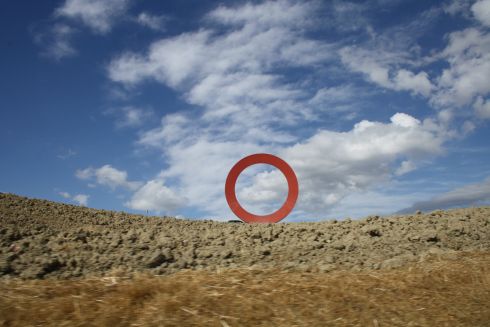
It’s on a hairpin bend as you drive west on the R 68 towards the outcrop of alum and alabaster upon which the town of Volterra sits.  The photo was taken from a moving car – a hairpin bend is after all not a point on the road which invites you to get out and set up your tripod – and much to my surprise, it’s come out almost perfectly (the roof of another car on the other side of the bend being the chief blemish).

A little bit of search engineering tells me that it’s Anello (Ring) by local born sculptor Mauro Staccioli, and just one of a number of pieces placed in the landscape three years ago.  It certainly beat seeing yet more of Anthony Gormley’s remorselessly advancing and rusting iron men in San Gimignano.

The landscape surrounding Volterra seems pale and a little eerie; Tuscan greens and golds blanched till they begin to resemble a moonscape in the white light of the afternoon sun.  That only adds to my feeling that Volterra would make a great name for an alien planet and species.  I imagine Volterrans being a flight of humans originally from earth, exiled millennia ago and evolving according to the terrain and the gaseous nature of the planet that they settled on.  Now they are ready to take back what’s theirs from the evil genius’ metal zombie master race currently presiding over earth.  We can only hope they are victorious.


2 Comments

Great glass elevator

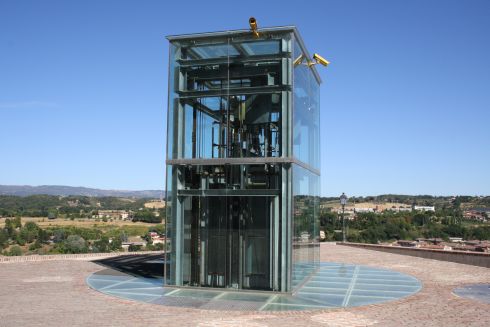
Colle di Val d’Elsa is a rather prolix name for a town, don’t you think?  And it turns out to be a somewhat elongated place too, being split into new town and old, the latter high above the new on a long, narrow peninsula of hill.  On the map we were given was marked a lift – ascensore – obviously for the purposes of getting up to the old town.  So we went looking for it and found instead only a steep incline folding back on itself as paths or roads tend to do when they ascend hills, and began to suspect ourselves the subject of a tourist-oriented joke.  It was only when we got to the top of the hill that we found it, landed like Charlie’s great glass elevator at the centre of a viewing platform looking down on the new town.  It seemed obvious to take a trip back down to find out where the lift came out, and how we had missed it.  So we did, and it was the strangest journey by lift I’ve ever taken; you go from bright sunlight to subterranean gloom, emerging at the bottom into a caved-out tunnel in rock, as cool temperature-wise as it had been hot in the open air.  The street entrance was unobtrusive, but the real reason we missed it was because there were two lift icons on the map, down below and up above, and – guilty of thinking that a map has three dimensions rather than two – I had guided us towards the up above icon without noticing the down below.  Fortunately I was quickly forgiven by the members of my party, on account of how truly peculiar the lift is.  Not to mention how sleekly cool, how other.

The old town was worth the climb, and the expense of the recent installation of the lift.  Two or three parallel streets run the length of the narrow hill, past churches, crypts, and crumbling palazzos; through shaded squares in which to sit, drink and gaze down from the hill or at the people passing through.  The founders of these old Etruscan towns chose their hills wisely and later inhabitants fortified them well; but I bet even then they wished there was a quicker way up and down them than by foot or horse power.  Well, now there is.


11 Comments

Birds [j]

I don’t remember when in my life I first became aware of birds.  Do any of us?  And yet they are a common experience to us all, rich or poor, city or countryside, north, south, east or west.  We must as children simply take them for granted, their chorus at dawn, the chatter through the day, their hush at night, broken only by the hooting of owls.  Perhaps we were fascinated by the hopping and pecking of sparrows, or wary of the gulls when they got too close for comfort on a beach.  Maybe our sense of wonder matched David Attenborough’s as he presented us with the extraordinary wattle of Temminck’s tragopan, or our imaginations were caught up in Tippi Hedren’s panic and terror as the birds gathered around her in Hitchcock’s film.  Or perhaps we simply had a father or a mother who liked to point out the birds in our garden and tell us what they were.

I didn’t have that, but I suppose my daughter does.  She’ll engage or roll her eyes, according to mood.  She likes to see them feed from the half-coconuts outside the kitchen window.  Dead birds are definitely interesting.  A tit beheaded by a sparrowhawk or a siskin’s neck snapped through collision with a window.  Both of those we buried.  Like the seemingly innate ruthlessness of the cuckoo, the sparrowhawk shows us that they have no scruples, that survival instinct rather than morals is what binds nests or flocks of them together.  But how hard it is not to think nature is inherently good when you wake to a dawn chorus.  In Cormac McCarthy’s The road, as much as anything else it is the absence of birdlife which renders his post-apocalyptic world terrible.

How then did I make my way to birds?  It was a small hop from the trees, I suppose.  Originally, from words, words printed on paper made from the wood of the selfsame trees.  From wanting to be a writer and believing that a writer should be able to describe the world, should be able to say which flowers are growing as characters pass across a wasteland or through a formal garden, which trees line an avenue in France down which they cycle, or, as a narrator soliloquizes about his life from the hard comfort of a picnic table, which bird has landed at his elbow.  From making this effort I know a little bit more than I otherwise might, but I still feel an ignoramus in front of the vast variety of the natural world.

But I keep perusing field guides and checklists, and as I have done with trees, perhaps I could also outline my life using the birds which have flown through it.  Sparrows, pheasants, and pigeons.  Herons, peafowl, and Canada geese.  Red-crested pochards, tufted ducks and coots.  Blackbirds, crows, and great tits.  Nightingales, of course.  Murmurations of starlings, tidings of magpies.  There has been the odd Garrulus glandarius too.

Keep your eyes peeled for birds with a twitcher’s intensity and you’ll see things you’ve never seen before.  Red kites soaring on updraughts where a plain meets a line of hills.  Falco subbuteo – the hobby – emerging from an abandoned crow’s nest to fly like a Brazilian footballer dribbles.  A charm or flutter of greenfinch chasing each other in and out of a hedgerow.

Near where I work there is a park and at its centre, an aviary.  I don’t much care for birds in cages, but we will insist on putting them there, and I suppose it is another means by which children come to know birds.  The other day I was circling this aviary and I saw two cockatiels copulating.  The male’s cheek was no more blushed with colour than it usually is.  The sex was rough and short-lived.  The female flew off as soon as it was over; no endless turtledove cooing here.  I wished the cockatiels an uncaged life back among their native Australian trees.  One in which they could stretch their wings whenever they wanted and raise their young to live free.

Leave a comment

In detestation of a barbarous Murder

A3

Former path of the A3 at Hindhead between London and Portsmouth.

The sailor's stone

The Sailor’s stone, with the former path of the A3 visible to its right.

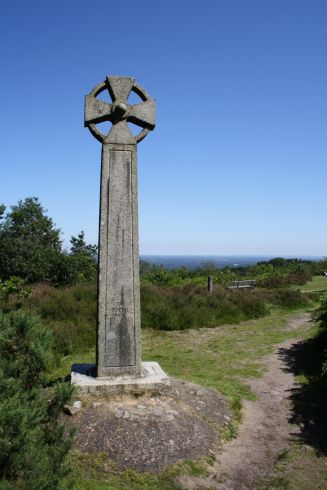
Celtic cross

The Celtic cross on Gibbet Hill.  From here on a clear day it is possible to see major London landmarks approximately 40 miles away.

Temple of the four winds

Plinth of the Temple of the Four Winds.


6 Comments

Char [t]

He became voracious, obsessive even, in his desire for novel savours.  A week never passed in which no new brew passed his lips.  Long gone were days of yore when all he drank was Earl Grey or Assam.  Now he quaffed far beyond even Lapsang souchong: high grade Rooibos or floral Manuka on honeyed, sunny mornings; herbal infusions such as fennel or lemon and ginger cleansed away a spicy lunch; while evenings saw him imbibe Masala chai or blackberry.  Office colleagues placing mugs under a samovar’s drip would likely consider him weird – a ponce, even – if he revealed how far his obsession ranged, how imperiously dismissive of cheap brews and milk he had become, so universally was such a sorry commonplace held: char was char.

Of course, come mid-morning or four o’clock, his preferred leaves were connoisseur brews: scrunched green gunpowder; hand-rolled Darjeeling, pale and mellow; hand-picked Nilgiri Orange Pekoe; and famous makes of Chinese ‘black dragon’ oolong hailing from Wuyi in Fujian province: Red Robe, Iron Monk, Cassia, Narcissus.  Noble and dangerous names which leisurely he unfurled in his mind; leaves he imagined picking in landscapes his eyes had never seen.

Some kinds he despised – he forbore from naming such cheap or queer-smelling brews. (Camomile was one; a brand famous less for savour and more for chimpanzees, a second.)  Like any obsessive, he disliked as hard as he loved, and you should know he would kill for a rare pack of Junshan Yinzhen yellow, allegedly beloved of Chairman Mao Zedong.

Before long he was mixing his own brews from leaves expensively purchased online.  He even essayed growing his own, a labour of love where a union of Camellia sinensis and Yorkshire’s growing season was concerned.  Success was variable; however, he was proud of his home-brewed Bai Mu Dan, whose fresh spring buds and baby leaves he had himself dried.  He ceremonially shared his inaugural bowl.  She much preferred coffee, and only acquiesced for love of him.  On occasion she feared he may be blinded by his obsession, wondered indeed if he was losing his mind; if char were peerless, life and she a mere second.  However, she had never wished him gone, would never cede him, even if someone offered her every leaf of char in China.  Caffeine junkie she may be – no force was required in drawing from her an admission of his calling: he had produced and brewed an unsurpassable cuppa.


5 Comments

Out of body [i]

Paula Weald had lost the means whereby she could conjure a sense of the person she was. Her ego was sorely taxed and self-observance had gone beyond a joke. Every day, she seemed to succumb to wound or trauma, and the only escape open to her was to leave her body. Detached then were her eyeballs and Paula knew not how she would be able to return those orbs to the sockets that usually housed and shuttered them. They floated free, roved above Paula’s head, former seekers of adventure and beauty now reduced to speechless autoscopy.

She had been a woman who never saw a handsome man that she couldn’t help but love the guy some; now she rose up above herself and the men she met and all she could see was the quarrelsome tangle of her curls and the spread of male pattern baldness. The faces were lost to her, as hers was to them. Nor could she puzzle out how she would become once more a person who looked out from – rather than down on – the body whose flesh and bone had once kept her heart warm. The phenomenon was a conundrum, for sure. The problem was momentous; the answer, one of moments. Moments slowly grown back together, become one. Whole; the self served.


2 Comments

Asylums

London plane

I have to go back to the old place first.  I left some confidential items in a locked draw on the last day but one, then managed to forget to bring in the key to the draw on the final day.  If the pedestal is moved, I’ll have to declare their loss, and all sorts of shit will ensue.  So on what is supposed to be day one in the new office, I go first to the old place to retrieve the documents, among them a thick and damning report about a local institution which never saw the light of day at the time it was put together.  That is, having had sight of its contents, the institution was powerful enough to ensure the report’s suppression.

The old office is the Mary Celeste.  It has the feel of being recently deserted, but not asset-stripped.  The lights are out and the humanising touches are gone.  The place has history; we were just a moment in it.  This solidly-built Victorian construction was once the city’s asylum.  Occasionally I used to fancy myself incarcerated, but I know there’s no comparison.

I go to another wing, a well-lit and better carpeted one, to seek out the old place’s legal eagle and show him what I’ve got, in the hope he’ll take it off my hands.  Jon sighs mock-wearily, and says with a breaking smile, ‘Oh, give it to the Echo.’  I make as if to hit him over the head with it.  But as I thought, and even though he has not seen it until this moment, he is happy to lock it in a safe place where it can quietly gather dust.  We say goodbye, and shake hands, wishing each other well.

I drive into the centre.  The new building is shockingly nondescript for one positioned at the heart of the city, and it isn’t any better on the inside.  Decked out in three shades of institutional green, with heavy dark brown doors leading off it, the stairwell depresses me beyond reason.  But I’ve been lucky with the desk allocated to me.  Looking out of and away from this grim building lining two sides of the square improves its aspect considerably; from this angle it is dominated by the Greek Revivalist mass of the old town hall.  I’m perched level with its frieze, watching pigeons wheel.  On the horizon I can see far-off hills, and beneath me the square’s bare-branched plane trees.  It’s a big window, a panorama of sky and stone with people constantly moving over the floor of the square.  In this corner I am somewhat distant from my colleagues, who I sense are also trying to overcome their initial feelings of dissociation as they unpack and arrange their new desks so that they resemble the ones they’ve left behind.  I feel an odd mixture of nerviness and dreaminess; the former at being among new faces as well as old, the latter in having such a distracting view.  I try to settle myself by writing something, by writing this.  The chimes of the town hall’s clock measure out the quarter hours.  There will be no escaping the slow flow of time here.

But then it’s not like I haven’t been here before, or somewhere very like it.

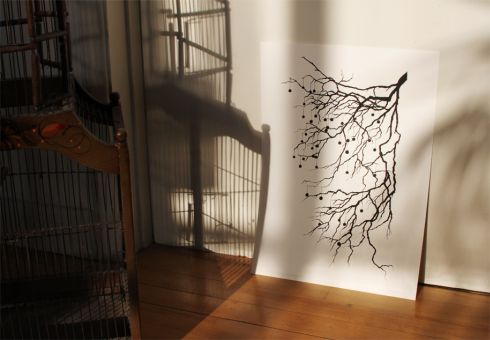
Photo of birdcage and ‘London plane on Hampstead Heath’ by Michael Goldrei via microsketchbook.


6 Comments

Everybody’s game

[The subject is everybody’s game.]  The game of words.  Because it is.  A game you play with others or against yourself, pitting your wits against language; one individual versus all who have shaped its regional form over the millennia.  And so every day I sit down to manouevre my editorial hoover around the stylistic louvres of my virtual oeuvre, chopping and changing and inverting the shape of sentences, avoiding repetition and hesitation but taking some considerable delight in deviation, and often borrowing as shamelessly as English does, as Georges Perec did.  I twist and twirl the nouns and pronouns and adjectives and verbs and adverbs and prepositions and conjunctions and interjections that have escaped the mouths and minds of others into sequences of words that only this random Shakespearean monkey could have put into precisely this order, with this particular intent, at this very moment in time.  [The buzzer sounds for ‘this’.]

Whether it goes onto be read or not is almost beside the point, although there is in me still some small obeisance to the Duke of Wellington’s injunction about the intentions of his mistress Harriette Wilson – ‘publish and be damned’ – to see whether the words I game into being having any kind of shared meaning, whether like a ball of soapy effervescence in a hot bath, they diffuse pleasure in the mind of a reader, perhaps even explode there, the pink flash of potassium coming into contact with the very same liquid.

And here we are, like 18th century pamphleteers, only with our knives and teeth largely blunted, pouring forth reams of words from electronic presses, trying to forge connections and kinship and perhaps even enlarged understandings of what it is to have language at our disposal; what it is to be human.  This silent lithography makes so much noise, but in among, there are words that speak to us, sentences that make us laugh or think, and paragraphs that reveal both ourselves and the lives and minds of others to us.  [The buzzer sounds for ‘that’.]

The game of words is a game which everybody can play; because of the internet, at times it can seem as though everybody does.  Yet online or off, in pubs and cafés and marketplaces and offices and stations and temples and hospitals, isn’t everybody in their enormously varied lives upon this planet regularly or at least at one time or another struck with amusement and perhaps even awe at the peculiarities and potential of words and how they can be strung together?  It may be a luxury to many, and you can’t even say that it is one which comes without a cost attached, but this modern day issuer of broadsides thinks we should all in our ways try to play it every day.  Because at its best, it is a game in which everybody wins.  [The buzzer sounds for ‘which’, but the whistle blows before the challenge can be made.]

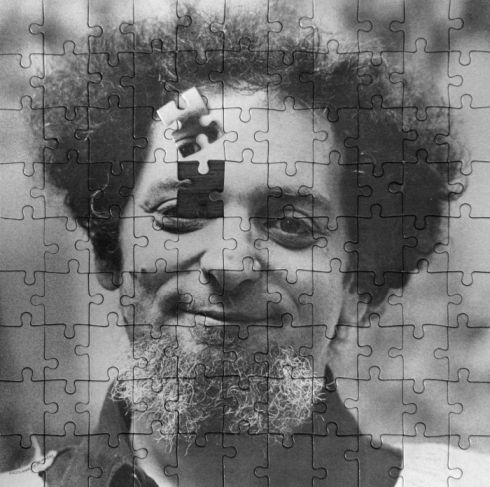
Puzzled image of Georges Perec via Arte Mosaico Ravenna.


1 Comment

I am still a tree

Scots pine

The scots pine with which I’ve been foolish enough to identify myself has survived the latest threat to it.  According to the council officer’s inspection report, its felling ‘would represent a significant loss of amenity to the locality’.  If you are a public servant writing to residents, I guess you can’t say that you’re granting a tree a reprieve because it’s beautiful, and a symbol of all that’s good in the world.  However, its two shorter neighbours have not been so fortunate.  Since they had only ‘limited general amenity value’ and were also reckoned to be a ‘potential hazard’, the week before last they were chopped down.

It seems to me that they were condemned more for not growing straight and true than for safety reasons.  But I liked how they were; they leant into each other like lovers (there I go again, anthropomorphising furiously).  Although perhaps it would be more accurate to say that one was seeking to avoid the kiss the other was leaning in to give.  Or maybe they were simply two old folk joined at the hip, bending their heads into the prevailing south-westerlies, and holding onto their hats.

The owner of the neighbouring property (now known as ‘tree-murderer!’ round these parts) will not be liking the fact that he has to plant one new tree of similar standing to replace the two he has been able to axe.  It’s a classic piece of quid pro quo political compromise on the local council’s part, dressed up with shaky and partisan evidence about safety, and it leaves no-one entirely happy.  But I couldn’t quite muster the energy to campaign for the preservation of the two condemned trees; thinking that if I did, it might ultimately tell against me and ‘my’ tree the next time it comes under threat, as it surely will.  So I guess I quid pro quo’d too.  Perhaps I should have more faith in the administration of local planning process, but I don’t.

In the end the most important thing is that I am still a tree.


4 Comments

The heron maiden

Even aged eight she was the kind to seize chances when they came her way.

You couldn’t miss her.  Her face was framed by a mass of red curls; her skin, a pale reflection of her hair.  She had often wished she didn’t stand out so, but now she was beginning to warm to the notion that it just might be a blessing rather than a curse to be so marked, so visible.  She didn’t want to slip through life unnoticed.  Instinctively she wanted to touch life and it to touch her.

This particular chance came in the form of heron’s legs, not quite fully returned to their usual trailing horizontal.  Or perhaps deliberately not returned; held out, for an adventurous girl such as herself to catch.

She was standing at the centre of the bridge in the middle of her home town, watching the river eddy round its piers, an endless fascination.  Because she was so rapt, the bird had escaped her attention, standing motionless on the edge of the bank upstream as it watched for fish beneath the refracting surface of the water.  Spooked by a movement close to, it opened its great wingspan and breasted the river.

What happened next happened by instinct – that of the bird coinciding with that of the girl.  Looking up from the eddies, she saw the bird looming.  The heron flew low over the bridge, and dipped its legs to her at the very same moment that she stretched her arms upwards.  She was small for her age and the bird was large for his type.  The bird’s legs hit her palms square and she closed her hands about their strong stems and was whisked into the air, just clearing the wall on the far side of the bridge.  Folk drinking in the sun on either side of it gasped as they saw her rise into the air, although an amateur ornithologist among them was more excited on spotting that the heron was an unlikely Great Blue than he was about it taking a small girl into the sky.

The heron’s wingspan was broad and sweeping and even under the weight of the girl he was able to keep rising.  She held on tight, her hands ringing the bird’s legs just above its feet.  She had swung herself around enough trees to have developed strong arms but after a while she found she could relax, and without trying too hard maintain her grasp of the heron’s legs.  Whether that was magic on the part of the bird, the support of thermals, or some quality that she herself unwittingly possessed, she wasn’t sure.

Those folk who saw her disappear into the sky that day often wonder what became of her.  Perhaps after a long time circumnavigating the globe, she lost the will to hold on and slipped from the heron’s legs over the deepest and most invitingly blue depths of the Pacific Ocean.  Or perhaps she came gently back down to earth not much further from home than she left it.  The watchers who saw her go never knew, and always wondered.

Photo of great blue heron by mauricholas via Wikipedia.

The inkbrain on The heron maiden: a Japanese folk-tale.