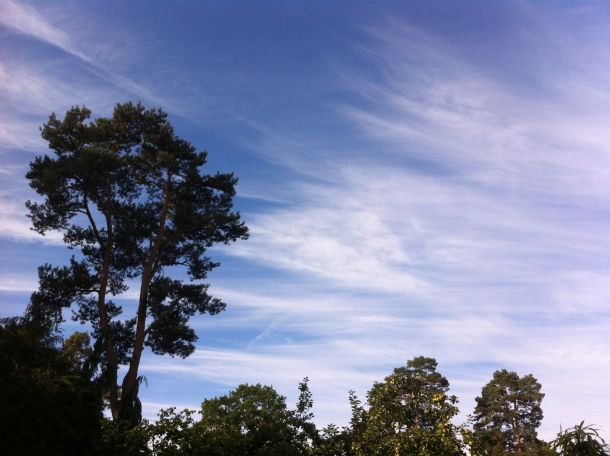
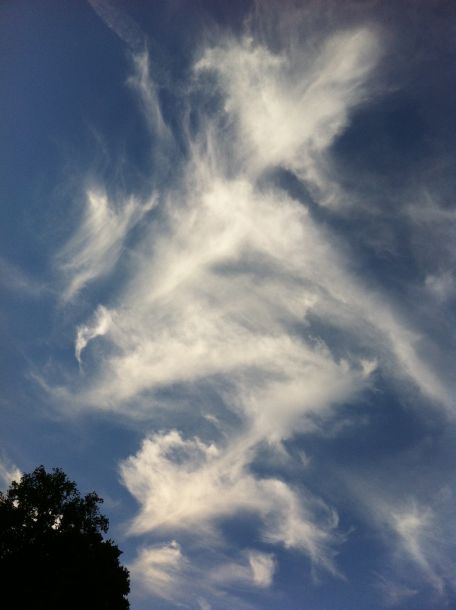
A wild slim alien


Leave a comment

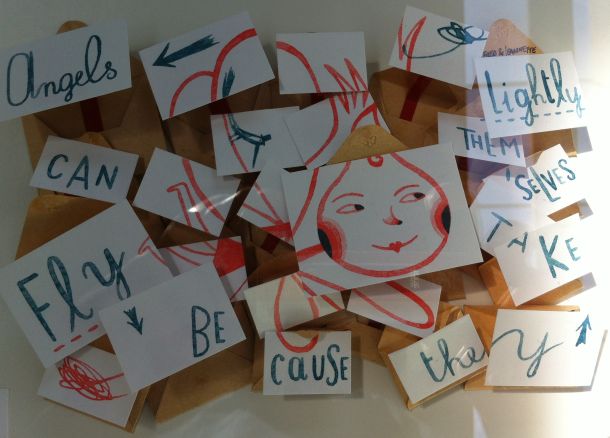
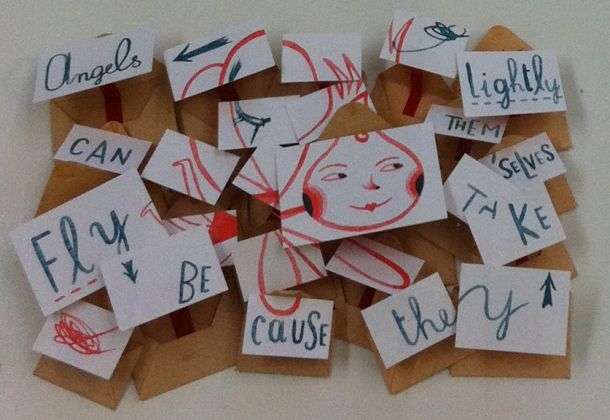
Angels can fly because they take themselves lightly

Thomas Heatherwick

Christmas card sent by Thomas Heatherwick to Wilfred and Jeannette Cass, 2010.  On display at the Cass Sculpture Foundation.

The source quote (originally ‘Angels can fly because they can take themselves lightly’) comes from a chapter entitled ‘The Eternal Revolution’ in G.K. Chesterton’s book Orthodoxy.

Thomas Heatherwick


8 Comments

The comical hotch-potch, or the alphabet turn’d posture-master: on writing lipograms (an afterword to Missing letters)

The comical hotch-potch

I’ve just completed a series of stories called Missing letters. Together they make up an alphabet of lipograms, a lipogram being a piece of writing composed entirely without a particular letter (or group of letters). I’m relieved to have finished, and now that I have, I thought it might be interesting to write about the experience of writing lipograms.

While I was working on the first letter in the series, I came across an article by Jonathan Franzen in which he contended the following:

‘My work represents an active campaign against the values I dislike: sentimentality, weak narrative, overly lyrical prose, solipsism, self-indulgence, misogyny and other parochialisms, sterile game-playing, overt didacticism, moral simplicity, unnecessary difficulty, informational fetishes, and so on. Indeed, much of what might be called actual “influence” is negative: I don’t want to be like this writer or that writer.’

Obviously there are some items in that list which most if not all of us would sign up to, but others – well, ouch. I can’t help feeling Franzen is being more than a touch prescriptive about his approach to writing.  He himself is guilty of at least a couple of the items with that very statement, let alone the essay as a whole. I loved The corrections, but ‘negative’ is the word here. We all come to writing from different places with differing intentions and motives. It’s not hard to imagine that Franzen has no truck with or time for the Oulipians. That’s authors like Georges Perec, Italo Calvino and Harry Matthews, who provided themselves with constraints which inspired the works they then went on to create. Perec it was who wrote La Disparition entirely without the letter ‘e’; not the first lipogrammatic novel, but probably the most famous, along with Ernest Vincent Wright’s novel Gadsby. Perec’s masterpiece, Life A User’s Manual, written with a full complement of letters, has a complex set of structural constraints based on a chess knight’s tour around a 10 x 10 grid, the squares of which represent rooms in flats in a Parisian apartment block. What the constraint serves to render is a beautiful book full of very human stories, some simple and sorrowful, others humorously fantastical or extreme. Life A User’s Manual or Calvino’s Invisible cities are just two answers to Franzen’s reductive critique.

Perec thrived on the challenges he set himself. You can impose rules on yourself and deliver something which you might not have achieved in any other way. When Franzen dies and is honoured with a sinecure in literary heaven, perhaps he’ll seek out Perec to debate the issue. And Perec might well wave a Gauloises in his face and say that it’s not a trick for trick’s sake. Likewise, though my stories might have been written another way with a different set of rules or a complete set of twenty-six letters, the resulting fiction still has depth of meaning. Playing a game doesn’t necessarily make the way the work unfolds any less emotionally true.

Would my stories have been better for being written unencumbered? The point is that they might not exist but for the constraint. From the choice of title onwards, the constraint shaped the stories and the stories fought the constraint. There are scores of different ways of saying roughly the same thing, and each of them has its own nuances. You choose the nuance which most closely resembles the truth of the fiction you have in your head. The constraint has also served to make me think that much harder about how to avoid the ease and restraint of clichés.

While Perec was the background inspiration for these 27 pieces of mine (I wrote a second story for U, suggested to do so by how the first unfolded), the immediate inspiration came from being reminded of and reading a more recent novel, Mark Dunn’s Ella Minnow Pea.  Forbiddingly subtitled ‘a progressively lipogrammatic epistolary fable’, in fact it is as whimsical as it is clever in following the troubles of islanders who successively lose the use of letters of the alphabet, as a result of the irrational authoritarianism of the island’s elders.  The islanders themselves battle back as flexibly as Dunn negotiates the ever-increasing constraint, and in so doing reinvents the English language:

‘Such a beguiling sight – your long auburn tresses falling as cataract in shimmering filamentous pool upon the table top, gathering in swirl upon your note paper – obscuring? framing? your toil.’

I can’t make such claims for myself, of course, but the commoner the letter, the more I found I had to bend the language, and come up with alternative ways of saying what I wanted to say, which often turned out to be better than the sentence I might otherwise have written. Each letter presented a different challenge. For some, conjunctions and definite articles were out; for others, participles and past tenses.  Every grammatical construct was at one point or another unavailable to me. But language, like water, can find a way around each obstacle it faces. And there is definitely a creative tension between the story-telling and the being one fork short of a full picnic set.

How Perec managed in the age before computers and word processors, I will never know. When I finished drafting a story, I habitually ran a ‘Find’ search on the letter which was supposed to be missing, only to discover there were often several and sometimes even tens of the little blighters highlighted in fluorescent yellow. S was the only story where none of the letter in question got through the net of my finished draft.  I guess it tends to stand out in a sentence.

Along the way, I had a wonderful comment from Lunar Camel Co., which got to the heart of what I was trying to do, and how I viewed the challenge:

‘I’m always interested to see, reading these, whether I’m aware of the missing letter — whether I’m noticing the writerly things you’re doing (not unlike tumbling) or whether I’m too caught up in the narrative to be conscious on that level. Often it’s a mixture of both, but I got too caught up in this one to think for a moment about who, what, wildcats, etc.’

The set of 27 is far from perfect. I only slowly realised that the lipograms were becoming predominantly fictional, and so a few are riddles or non-fiction, and maybe one of these days I’ll have another pass at those letters. Probably some of the narratives need a little more room to breathe, and perhaps if they were appearing in book form rather than here, they would get that.

To which letter would I direct you, if you wanted to sample one in particular? That’s hard. Ironically the last letter of the alphabet is possibly the best story, about a woman leaving a relationship as a result of an ant invasion – but that too would not have come into being but for the suggestion of the missing letter.  Combining Perec and Calvino in a two-headed Hydra for U – imagining first an alien poaching and eating her eggs in The reader [u] and then a talking horse in The horseshoe [u] – gave me most satisfaction and fun. On one occasion a single lipogram wasn’t enough to contain a character’s story so she returned in another – I [b]’s anthropologist is a lone survivor on another planet, until she meets her end in We [r]. Another memorialised a pub in my home town – The Cupola House [q] – which sadly burnt down last year. There was a lot of life, death and meaning in these stories.

But if you forced me to settle on just one, perhaps I would suggest the playful love story that is CK & U [F].  That’s what it all probably comes down to. That I am playing with letters, with words, for the sheer joy of it.  Perhaps it’s what I like to do most of all.  Jonathan Franzen too, I suspect.

And now? I’m not sure what the writing future holds in store. But I am certainly looking forward to being able to use the alphabet’s full range, without constantly double-checking myself for a letter which ought to be missing.

Image of Carington Bowles’ The comical hotch-potch, or the alphabet turn’d posture-master, 1782 via Granger Art on Demand.


4 Comments

From your favourite sky

IMG_1223s

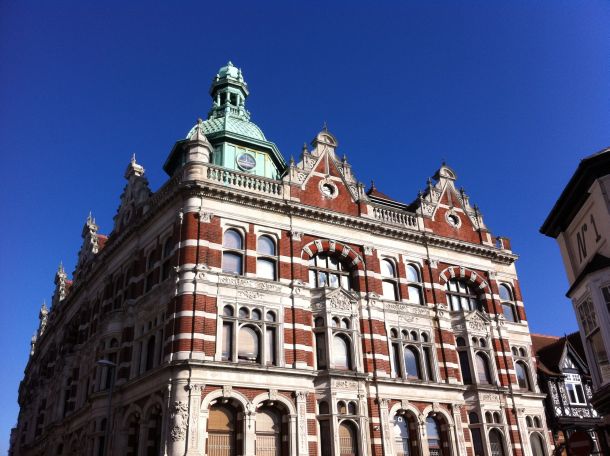
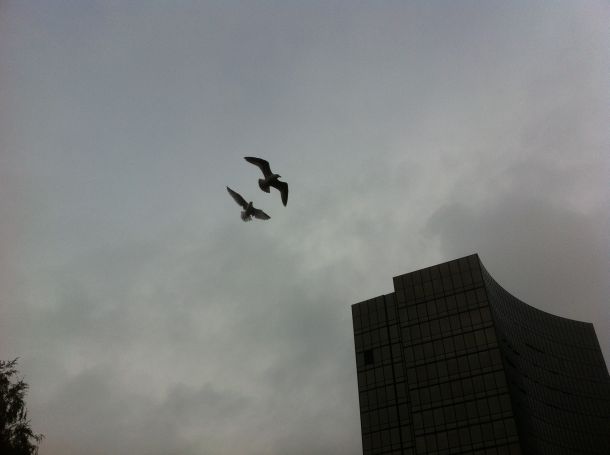
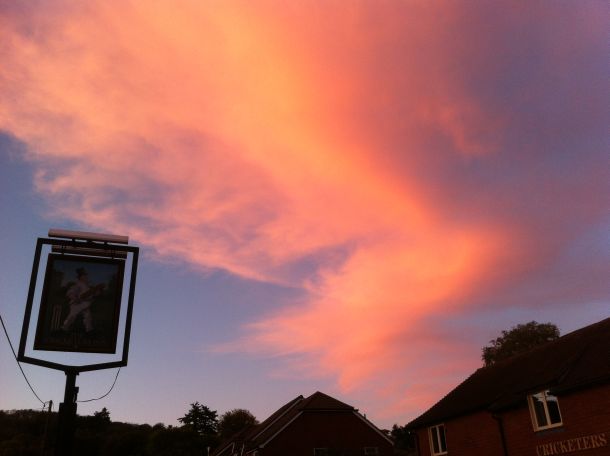
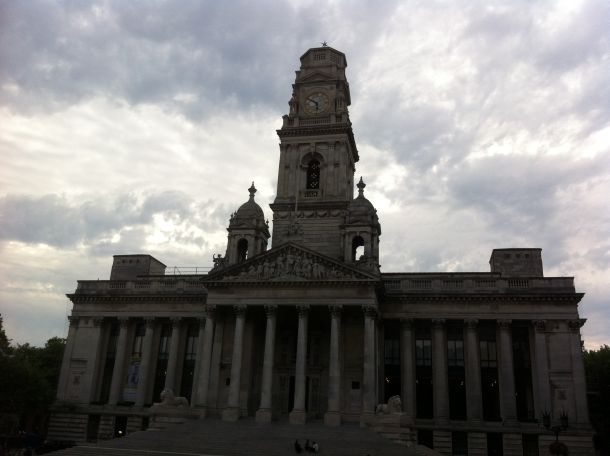
I can pinpoint the moment.  It was standing in the park by the cricket ground while my daughter played on the new zip wire.  I looked up from my phone and out across the field and the vast sky full of huge summertime clouds seemed to beg for my attention. I shot the sky where I stood. The next day, strolling through the centre of the city, I did it again.  And then I thought about posting the results.  So that’s what I’ve been doing ever since, at From your favourite sky.

Of course I’m far from the first to point my camera predominantly at the sky on a daily basis – Alistair shoots summer skies every year – but we all see the world differently; one person will completely miss what another sees, and vice versa. No two sets of daily photos would be the same.

The iPhone is not equipped with the greatest camera in the world but taking a photo to post each day is teaching me how to get the best out of it.  My framing gets better all the time, but in a sense that’s not the point; it’s more to make a record, of the days, of the skies, of the transient majesty of clouds.  In this country, in the space of a day, you can see so many different kinds of sky, though I confess I probably have already developed a tendency to discard overcast in favour of moments when the sky turns more interesting shades or colours.  Enough blue to stitch a sailor’s suit is often sufficient for me.  Nevertheless, photos on certain days seem distinctly ordinary, or even dreary; others come alive with structural detail from trees and telephone wires and buildings.  Trees in particular provide a land and sea-style contrast with the sky.  Inevitably there is an element of repetition, because generally I am in the same two places during the week; but there is variety in the repetition, an endless fugue.  Fundamentally it’s another way of saying, here I am, this is me, this is what I will see today, this is what I am seeing right now.  A daily postcard; a declaration of the everyday, each and every day.

Some days I take just a couple of photos, one to fulfil the requirement I’ve placed upon myself, another as insurance.  Others I will see wonders above me everywhere I look, and will take dozens, choosing the best later, and finding that I have to drop photos which are far better than the days preceding or following.  So far, I’ve only once been called a freak for pointing my phone at something it appears that only I can see.

At the beginning my intention was to do this for a year.  Now I think it will have to be a little longer, because one day, so absorbed was I in writing words, I forgot to take a picture, much to my annoyance when I realised too late the next morning.  (I wrote about that day instead, in far fewer than a thousand words.)  So to achieve 365 days in succession, completion date will be 3rd October 2014.  As long as I don’t forget another day along the way.

Here is the first of two selections of my favourite favourite skies so far:

IMG_1134s

IMG_1514s

IMG_1528s

IMG_1723s

IMG_1977s

IMG_2200s

IMG_2234s


Leave a comment

Water and ground in their extremity

awildslimalien's avatarA wild slim alien

water_ground

Sheep’s Head peninsula, Ireland, date unknown.

When you have nothing more to say, just drive
For a day all round the peninsula.
The sky is tall as over a runway,
The land without marks, so you will not arrive

But pass through, though always skirting landfall.
At dusk, horizons drink down sea and hill,
The ploughed field swallows the whitewashed gable
And you’re in the dark again. Now recall

The glazed foreshore and silhouetted log,
That rock where breakers shredded into rags,
The leggy birds stilted on their own legs,
Islands riding themselves out into the fog,

And drive back home, still with nothing to say
Except that now you will uncode all landscapes
By this: things founded clean on their own shapes,
Water and ground in their extremity.

– The peninsula by Seamus Heaney

View original post


2 Comments

Tomorrow’s harvest – synopsis of a film

Gemini
It begins in June. A week after his birthday, in fact. A sickness falls upon the people of the earth. First accusations fly, then counter-accusations, then finally bombs. The apocalypse doubled. Wires fall silent as residual power fades. Only the odd transmission now, from who knows where and whom.

Reach for the dead
A couple are parted at the time of the apocalypse. In a week its work is complete and life as we know it is beyond hope of rescue. Everyone he knows and loves is dead, but for inexplicable reasons, some have survived, he among them, and he can’t help daring to hope that she may have been immune too. Away visiting in the hills of the north, perhaps she has been protected from the worst of the dual catastrophe.

White cyclosa
For a few days, he remains at the far extent of the suburban fringes of his provincial city, keeping a low profile, sniffing out a sense of the scale of the disaster, and how he might navigate his way to her, for it doesn’t take him long to realise that survival depends on leaving for the rural isolation of the north. Enlarged, irradiated spiders climb the walls and drop into his hair, freaking him out almost more than the gruesome sights he encounters on the streets.

Jacquard causeway
In a Jeep, and then on foot, he journeys to her. Dodges wrecks and barricades and attempted car-jackings. Goes off road when the main routes become impassable. Switches to walking when the petrol runs out. Sticks to the back ways, the lanes, a compass hanging around his neck, always aligned to the north. On the way he faces many dangers. Brigands wait at one end of a causeway across a marsh; with the press-gangers who have dogged his every step behind him, he cannot go back the way he came. He has no choice but to brave the cold, swampy soup of the marsh. On the far side, he comes across an orphaned child who has escaped from the brigands. He accepts his obvious duty to look after her. She has with her a dog, who will the very next day save them from a murderous psychopath, with a warning bark and then a savage attack.

Telepath
He knows that his love will have remained where she was, looking after any of the frail about her to have survived and fearing the worst about him because of his proximity to one of the apocalypse’s many likely epicentres. But the mind is a powerful thing and half-wishing, half-deliberately she transmits to him that she is still alive, that she loves him, that she knows he is coming for her, and that just as she won’t give up on him, she knows he won’t on her, no matter what. He receives the messages in a feverish waking dream, the girl leading him by the hand. He burns hotter with the exultation of knowing that his love is still alive, that she waits for him. Neither knows how long it will take but both believe that one day, maybe sooner, maybe later, they will be reunited. He counts the days.

Cold earth
At one point he and the young girl are travelling down a long holloway during a violent storm. It ceases as suddenly as it started, and at that moment the ash clouds are parted and sun breaks through for the first time since the week of the apocalypse. The canopies of the holloway shield the sunlight except for slivers and chinks. Distraught with wonder, he thinks: how could we have let such beauty go to waste? And yet somehow there are still birds to sing at the sight of the sun, offering the travelling pair hope.

Transmisiones ferox
With fierce determination, man and girl learn together the arts of hiding, foraging, and hunting, in that order of necessity. The girl has a better grasp of the fruits of the forest than he, while – having previously been a vegetarian – he learns to skin an animal through trial, error, and a book borrowed on permanent loan from an abandoned library. At night they search the airwaves on a battery-powered radio, but the only patterns in the static are the ones they imagine themselves.

Sick times
When sickness gets the better of him, it is the girl who finds them an isolated house in which he can recover. The cellar has two exits. There they lie low. She makes him nettle tea and salves his sores with a paste made from the same leaves. With the plasticity of youth, she is adapting to the new state of things, this post-apocalyptic landscape, far better than he.

Collapse
They resume their journey, but this time it is the girl who gives way, falling prey to radiation sickness. And now in another hideout, he nurses her back to health, using a pharmacy’s formulary and drugs, all the while wondering whether or not human evolution will be able to outpace the anatomical effects of nuclear fall-out. This girl is a survivor, though, and soon they are able to press on, close now to their destination.

Palace posy
Meanwhile, racketeers are keeping his love against her will, but because this is a story, an artifice, somehow her dignity will have been spared her; or, at least, she will not speak of it to him once she has been rescued. Though perhaps it might be that the brigand’s leader genuinely has fallen for her, and has shown himself to be a patient if dangerous man.

Split your infinities
Through binoculars he studies their encampment, an old farmhouse whose dry stone walls have been topped with barbed wire. He stakes it out and watches the comings and goings, the girl waiting patiently at his side, and the faithful hound at hers. When his eyes tire, she takes her turn to watch and note. On the third day he catches sight of his love at the back door, pausing for air with what looks like a kitchen implement in hand. He risks standing, so that she can see him, and anyone else might – a chance he feels he has to take. After a time she turns in his direction, and visibly starts. With his arms crossed in front of his chest, he signals a kiss. But she is called back inside, and needs must go, not daring to look round.

Uritual
With the girl bedded down in a house as safe as any in these times, he keeps vigil into the depth of that night, awaiting the moment when he will attempt the rescue. Through binoculars, in the fading light of the evening, his heart has jumped to see a window marked with an X in parcel tape. Now he knows where to go, and what he has to do.

Nothing is real
His heart pounding, armed with wire-cutters, rope, a gun, and climbing gloves, he runs across the open fields to the stone wall perimeter. He cuts through the barbed wire, and follows the shadows cast by the outbuildings until he comes to the drainpipe he hopes will bear his weight. Even with the gloves, it’s a struggle to climb, but somehow he manages to make it to the roof that will allow him to access her window, if he can keep his balance across its apex. After a pause to steady his nerves, he runs it, and makes the safety of the wall. Then she is there at the open window and with his mind outside of his body he tells her to secure the rope to one of the feet of her bed. She has a rucksack of things ready on her back. She knew he was coming for her. They only dare to embrace once safely beyond the barbed wire perimeter, and that’s when his mind and reality both come crashing back into him.

Sundown
It is their first day together as a family of three. The woman and the girl are shy of each other, but he can see the first signs of friendship and what will become love. He is mortally tired after the night and the days spent watching and one in which they tried to put as much distance between themselves and the farmhouse as they could.

New seeds
They find the perfect house, one built into the side of a hill, all but invisible from the passing road. A nearby clearing in a wood becomes their allotment. Whenever they venture out, danger and distrust go hand in hand, but gradually, through chance encounters, a network is built of people intent on surviving whatever the poisoned world throws at them. All for one, and one for all, they stockpile food, fight off threats to their security and raise their children.

Come to dust
Dust storms are a condition of the new life, but safe in their hillside home, the growing family – now supplemented by twin boys whose survival instinct is as strong as that of their parents – rides them out, and afterwards, sweeps up everything back to a state that they are beginning to dare to think of as normal.

Semena mertvykh
In many ways the new life is an idyll that surpasses the old. But it’s impossible not to look back, and mourn what has gone, what has been lost from the world. Mourn the individuals, the millions, the billions who died. In any individual who survived the end of the world, the will to do so must have been strong, but both the man and the woman have a sense that this is fed by the determination of the species as a whole not only to endure, but to live free. The fate of the dead informs all of the living yet to be done.

3 Comments

We [r]

Anna lay dying.  The disease against which she thought she had immunity had at last eaten its way deep into a body unable to fend it off.  Not long dead themselves, the colleagues she had lost had now become ghosts alongside the people whom she had left behind at home.  They moonwalked the modules of the silo, and leant down to pillow level to speak quietly unsettling sentences about joining them into Anna’s pinnae.  She hadn’t sufficient pep now to close the blinds, and watched the days pass double quick, two against each slow one back home.  The leafy giantwoods outside cast shadows which sundialled the walls of the sleeping pod like speeded-up film.  She had the sense that time was scuttling to a point, and existence likewise – the full stop following which it would not be possible to say, I think, so I am.  She would not be thinking, she would be dead, although life on this odd planet would still go its seemingly infinite way.  No-one was left to put Anna in a box and the box in the soil, and eulogise beside the gaping hole.  But then millennia would see to it that Anna’s skeletal body was slowly compacted into a seam of fossil fuel which some subsequent colonising species might use to heat living spaces whose design she could only dimly imagine.

These thoughts came in clipped pulses, and between them – as she phased in and out of consciousness – was white space onto which the annals of Anna’s mind flashed a slideshow of images.  Times past, landscapes she had walked.  A balloon against a sunset.  A dog and its dancing shadow as it jumped in a meadow with a deep blue sky above.  A pumpkin, its jagged teeth, nose and eyes alight with menace.  A headland and below it a beach, glistening wet in the sun.  A cove on the same wild and wind-smashed coastline.  A white sand beach and two caves; placed between them, Anna’s own walking boots.  She felt the feeling of naked feet and toes in sand as she stood in one of the two caves looking out; a keyhole of light doubled at the bottom by a pool left behind as the tide ebbed.  A snowscape with stone walls.  A small wooden shed in a lush, sloping field; the angles of the hillsides led the eye to that little building clinging to one of them.  A goat standing atop a dusty bank next to a stack of baled hay, upon which the animal was feasting.  At the goat she laughed, and the sound she made, so unlike a laugh, shocked Anna into consciousness again.

Then above the wind, a sonic boom.  In the last gasp of depleted faculties, Anna knew it must be the salvage mission.  Salvage, because they wouldn’t be expecting to find anyone left alive.  A blast of synaptic agitation emitted itself deep within a mind which had once been fine and difficult to shake.  Why now, just as she was about to die?  Couldn’t they have waited, have given these final moments the peace she wished them to have?  She didn’t want to be found mouth open and spit hanging and with clothes which smelt of shit and piss.  Would that she was instead simply a skeletal boo!  She thought of the duck-billed platypus in its glass case; Anton’s find, his joy on display.  Yes, that was what she now wanted to be.  With Anton, back home.

The noise should have faded as the ship touched down, but instead the tail of its descent seemed to be met with the exclamation point of an explosion.  It jolted Anna’s mind alive, and she had now one final chance to validate the Cogito.  But it was not so much thoughts as images which began assembling.  Again Anton came to mind, and without a shadow of doubt she knew he was on that flaming ship, come to save his one-time love.

Images of what they had seen hand in hand flooded Anna’s mind, as if they might be unspooling in his quaking consciousness and telepathically passed to Anna’s.  Six silhouetted ponies on a beach with the tide out.  Yes, that day!  A boy had been unseated and the spooked pony had bolted into the town, causing havoc.  If telepathy was somehow possible, then Anna could conceivably pass images back to Anton.  So she sent him jumping into the Blue Lagoon, focussing especially on those pulse-heightened moments in advance of stepping off the cliff.  He sent Anna an image snapped by his mind while they had stood high on the cliff above looking down on the lagoon.  This was like magic!  She sent him the moonscape of limestone paving they had once visited at the end of a solid day’s walking.  He came back with dunes in which they had made love, the lapping sea to the east, the flat of cultivated, quiet land and a distant temple to the west.  Next she gave him a mountain top, an island and the lapis lazuli in which it was set like a piece of jade.  The palette of this image must have made Anton think of that peacock, defiant atop the gable of an old stone building.  Then what about the peacock and peahen they had seen sitting face to face on a fence, effectively kissing?  She sent him that, and saw his smiling face.  Anna smiled too, but now the end was close.  She wanted – needed – to see these scenes again, to have new sights to hold in common.  It was so unjust; she wasn’t done yet.  She wanted obstinately to live, tight to the point at which she and Anton simultaneously died.


5 Comments

Written in the dark

I’m not sure what woke me; it’s too deep in the night for it to be early morning dreams.  Perhaps the territorial screeches of battling wildlife.  Oh, but then as I shift position, a twinge inside my rib cage – the acid of reflux.  It’s snapped me awake.  I can tell I’m going to struggle to get back under.  An avalanche of images, thoughts and concerns is triggered by the noise of my mind coming to life.  Gradually I whittle these away until there remains the essence of an idea; a netsuke that I will set aside time to carve in miniaturist detail, if only I can remember its essence tomorrow.  I don’t want to disturb my partner sleeping next to me, so I have only two options; to repeat a concatenation of reminder words mantra-like before I fall asleep in the hope that I’ll remember them tomorrow, or to better ensure I do so by writing blind in pencil on a clean page at the back of the notebook I keep on my bedside table.  As you can imagine, this is a hit and miss affair.  I restrict myself to those key words that I hope will convey to me the idea as a whole when I look at them the following day.  But sometimes I struggle to read notes to myself written in full daylight; written in the dark my letters will loop crazily, while ‘t’s will be missing their cross bars, and ‘i’s their dots.  Words and lines will overlap.

The following morning I am improvising or even riffing in the car as my subconscious drives me to work.  My mind is trying to find something on which to latch and around which to gather.  I am thinking of the infinite variation of repetitive journeys, because early on in this one, someone ran across the dual carriageway between the two petrol stations on either side of the road, hurdling the barrier in the middle.  This has never happened before.  The man is wearing the kind of fluorescent protective clothing a fire-fighter might; perhaps he’s a petrol tanker driver.  Automatically I hit the brakes, because naturally I don’t want this real life game of Frogger to come to a sticky end.  The proximity of death shakes me, though admittedly in not quite the same way as when I put my own self in the way of vehicular harm.  I could continue on in this vein, noting all the variations from the norm of the drive there and back – the different birds I sight, the endlessly changing landscape and skies, the faces and bodies and clothing of the pedestrians I let cross at the roundabout.  In so doing I could show that there is some kind of variety in the rote of routine, if you choose to look for it.  But these thoughts are elbowed to one side, by not one but two new netsuke.  The first is the resumption of last night’s musing on writing in the dark.  The second is an entirely novel idea; as I glimpse it come into being I see also how it may move my writing forward, in a new direction.  The essence of the idea is contained in about six to eight words.  Now I know I need to get to the car park double quick and write those words down before I lose them forever.  Because if that happens, I won’t be as sanguine about it as Yuri is in Pasternak’s Doctor Zhivago:

‘So many new thoughts come into your head when your hands are busy with hard physical work, when your mind has set you a task which can be achieved by physical effort and which brings its reward in joy and success, when for six hours on end you dig or hammer, scorched by the life-giving breath of the sky.  And it isn’t a loss but a gain that these transient thoughts, intuitions, analogies, are not put down on paper but forgotten.  The town hermit, whipping up his nerves and his imagination with strong black coffee and tobacco, doesn’t know the strongest drug of all – good health and real need.’

Inevitably my attention is diverted by the flashing lights of a slow moving vehicle, and by other slightly less slow moving vehicles moving into my lane to overtake them.  When I settle back into driving on autopilot and resume my conscious attempts to turn ideas and feelings into words, I find that while I can remember the writing in the dark idea, the novel netsuke is gone.  I try to smoke it out as methodically as a private detective might uncover the address or no fixed abode of a missing person.  I rewind, scroll back, follow the links that form the chain of my thoughts, handling each one in turn.  I jump to the start of the journey, and even beyond that to my shower before setting off (it’s another place where ideas come to me).  But the chain is broken and the missing link refuses to be brought back into sight.  I turn off the music – Dead in the boot, appropriately enough – in order to let my mind run free, because I know now that I’m straining too hard to remember.  If I just let myself drift into the drifting mood I was in before the slow moving vehicle blocked the way, before the anxious seeking took hold, I’ll surely remember.

But the netsuke is gone.  It may never now be carved.  As in the night-time, I wish I had an inky pipe going out of my brain onto a page which I could look at the next day, or perhaps a chip with something akin to a telepathic recording facility wirelessly connected to a laptop.  Maybe there will be such things in twenty or fifty or a hundred years’ time.   (You may be thinking, but the technical solution already exists – the note-taking app on your phone!  Unfortunately in the dark my eyes can’t cope with the glare from its screen.)  I can still feel that it was a novel thought.  But perhaps that’s why it didn’t stick, because it was brand new, and not a familiar theme or notion circling overhead, frequently visible in the past but never yet butterfly-netted.

These written in the dark thoughts are of that kind – so much easier to pull into the shape of words than that fleetingly glimpsed hint of new connections which ultimately proved not quite strong enough to live.  Still, I am full of frustration, mourning its loss; is this what dementia will be like, only with the connections that connect each item in the ordinary store of memory severed?

At the turning for Rowlands Castle, under my breath and as so many times before, I sing ‘Through the last light on the plain / Roland to the dark tower came’.


7 Comments

Marvels of things created and miraculous aspects of existing things

marvels

Dear reader, my Christmas gift to you is this – Hidden treasure: the National Library of Medicine – a fabulous, beautifully illustrated and freely available ebook detailing some of the riches in the collection of the National Library of Medicine in the US, and emanating from the point at which personal interests and my working life collide.

To give you a flavour, among my favourite of the revealed treasures are the Langenburg Manuscript (a 16th century compilation of texts about the health and maintenance of horses), nurse postcards and uniform photograph collections, White’s physiological manikin, Marvels of things created and miraculous aspects of existing things (a 13th century Islamic cosmography), examples of hirsutism from the 1876 edition of the Atlas of skin diseases, Theodosius Purland’s mesmerism scrapbooks, the Numskulls-like wonder of The wonder in us (popular science from 1920s Germany), Chinese public health slides, St. Elizabeths magic lantern slide collection, a 17th and 18th century book of receipts for remedies, and covers and pages from Scope magazine.  Plus lots of other weird, wonderful and grotesque medical stuff, and accompanying each item, short essays by scholars, artists, collectors, journalists, or physicians.  It’s not an entirely scientific trawl through the history of medicine, but it illuminates a creative energy from across the centuries in which medical science is married to art.

It’s an irony of course that this is an ebook celebrating hard copy words and pictures in all their varied and magnificent forms; books you’d really like to get your (white gloved) hands on.  But it is also itself available in hard copy, if a preference for the heft of a book in your hand and the feel of pages as you turn them beats the cost involved.  Or you are stuck for a last minute idea for a Christmas present.  It’s the kind of book I’d like to receive myself, and I feel somewhat frustrated that among those to whom I routinely give presents, I can’t quite imagine who I’d aim it at.  The same goes for the equally enticing Book of barely imagined beings: a 21st century bestiary.  But at least I can draw both books to your attention.

Merry Christmas to all my regulars, and to anyone stumbling into this alien domain for the first time.


Leave a comment

Star of wonder

Sagittarius

A while back my daughter asked me, ‘Is there a video of me being born?’  I laughed, and said that even if we’d had the camcorder then, I would have struggled to get sign-off from the principal actor.  Aside from a few photographs, the day went unrecorded except in memory, where the magnitude of the event runs up hard against pain, anxiety and lack of sleep, to speak just of what her father experienced.  But it was a nice piece of inference on my daughter’s part; she has been using the hand-held camera a lot lately, and knows there is footage I shot when she was much younger.  So I told her that I had in fact written something about her birth not long before, and that maybe when she was older she would be interested to read it, in the absence of video evidence.  I thought I would try it out here first.

*

I was out shopping for Christmas presents when your mother went into labour.  When I got home she was sitting on the floor with her back against the side of the bed.  She almost never shouts at me, but she did then, exasperated by my overlong absence, though I knew that it was born of anxiety and nervous excitement, rather than true anger.  And in any case, when we rang the hospital, they were reluctant for her to come in yet.

Once she was admitted later that evening, the long hours – a whole day’s worth of them – passed like no other long hours have passed before or since.  A heightened state of waiting, marked by minor developments, moments of concern, waves of pain.  Gas and air and an epidural.  The birth plan went out the window, an impractical ideal.  The simple truth is that obstetricians know what to do in any given situation, and their arguments carry both urgency and the weight of countless practical repetitions.  So labour ended and your life began in theatre, with activity just short of taking you out via the tummy.  I was invited to wear scrubs and sit where I could hold your mother’s hand.  It must have been a quiet time on the labour ward because with us there were about a dozen health professionals, led by a friendly and charismatic obstetrician with wiry grey hair and sideburns, an auspicious sign from my point of view, and one which I suspect influenced me to grow my own early in your life (though the effort shaving became may also have had something to do with that).

Against his advice, I stood up to see you born.  It had seemed traumatic as labour went along but then you were out, bloody and pink; the elation we both felt made the trauma seems so much less traumatic.  The obstetrician announced the time – 16:58.  Tuesday’s child.  Despite being ventoused and clamped with forceps, you were pink and perfect and – I can’t resist using such an old-fashioned word – bonny.  I have a dreamlike memory of being given you swaddled to take over to the paediatrician to check you for APGAR (Appearance, Pulse, Grimace, Activity, Respiration); pink as you were, you scored high.  Certainly I looked into your seemingly astonished and certainly astonishing face moments after you were born, and my recollection is that it was as I carried you across to the paediatrician that I spoke your name for the first time, even though your mother and I had not yet agreed it.  But the moment I saw you, it was obvious to me that you were who you were.  Obvious too that you were beautiful.  In the weeks ahead, everyone would say so, from midwives to passing shoppers in the supermarket; and once a health visitor added, ‘of course we say that to every parent, but she really is a beautiful baby’.

On the maternity wing, a student midwife took the first photo of the three of us together, and I took one of you being weighed in: 3.548 kg.  I can even tell you that you were 50 cm long.  We heard you cough for the first time, and saw your tiny tongue appear.  You looked bewildered, as you had every right to be.  You tried out your first grouchy frowns beneath your bloodied mass of hair, for yes, like me you were born with a full head of it.  Your fat little lips almost arranged themselves into some distant relative of a smile.  Your eyes were immediately questing, your thighs pudgy and your knees strong.  You had a dimple where I do.  Every time we looked at you in those early weeks we saw another face emerging out of your blooming cheeks.  You were a barrister clutching the imaginary lapels of your baby-grow and addressing the ladies and gentlemen of the jury.  A little Buddha or the last Emperor.  In nappy alone, a sumo wrestler, or a miniature heavyweight boxer.  A Mafia don.  Winston Churchill.  Friar Tuck.  Benny Hill, leading us a merry dance.  But beautiful versions of all of those large personalities.  At times you seemed to be playing an imaginary theremin, or perhaps a double bass, with swoops of your tiny hands.  Or you were a conductor whose emotions were rioting carefully across your face in time with the swishing of your imaginary baton.  Oh, the faces you pulled.  Maire Antoinette, dismissing the hoi polloi.  Frank Sinatra singing ‘My way’.  Vic Reeves’ impersonation of a club singer, crooning out of the side of his mouth.  But when you had been well fed, and hadn’t a care in the world, then what you most resembled was a cat.

The period a few hours after your birth is dreamlike in my memory.  Remember, I hadn’t slept for more than thirty-six hours.  Perhaps that’s why instead of driving home, I have what seems a puzzling memory of catching a bus, a London bus wanly lit in the way London buses are, rumbling and bouncing and lulling me as it moved through a magical neon-lit world which in reality was for the most part suburban housing – twenties mock Tudor and thirties terraces and semi-detacheds – lining the ceaseless rumble of the main road.

At home I must have had something to eat.  I strongly suspect I drank a bottle of beer, perhaps two.  I certainly turned on the radio to listen to John Peel, wanting music and to share the moment with someone, even though I would never have gone so far as to email the DJ to let him know about this momentous event in the life of one of his longtime listeners.  That night Peelie played a whole host of songs which gave me the uncanny sense that somehow he nevertheless knew what was going on in my life: ‘I love your mum’ by the 7-10 Splits, Cosy Cosy’s ‘About a boy, about a girl’, ‘How the angels fly in’ by the group in session that night, extreme metal outfit Anaal Nathrakh, ‘Darlin’’ by Frankie Miller, sweet Gene Vincent’s ‘Baby blue’, and even ‘Clappin’’ by a group called Bus.

On your 18th birthday – to which you are now halfway – I’m going to give you these words, and together with them, a recording of that show, if I can find one, and if not, then as many of the songs as I can trace compiled together in the order they were played.  Against my better judgment, I might even throw in that week’s number one: ‘Changes’ by Kelly and Ozzy Osbourne.

Photo of the Milky Way and the Sagittarius constellation by Terrence Dickinson via Hubble.