A wild slim alien


4 Comments

From your favourite sky

IMG_1223s

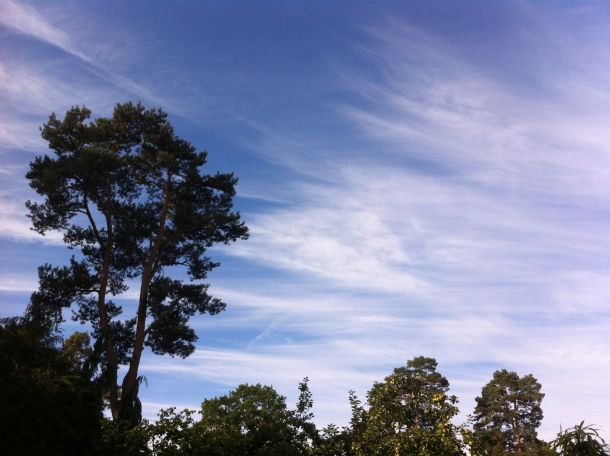
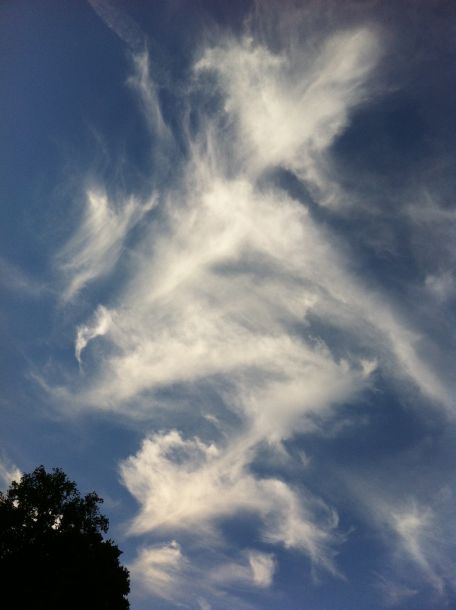
I can pinpoint the moment.  It was standing in the park by the cricket ground while my daughter played on the new zip wire.  I looked up from my phone and out across the field and the vast sky full of huge summertime clouds seemed to beg for my attention. I shot the sky where I stood. The next day, strolling through the centre of the city, I did it again.  And then I thought about posting the results.  So that’s what I’ve been doing ever since, at From your favourite sky.

Of course I’m far from the first to point my camera predominantly at the sky on a daily basis – Alistair shoots summer skies every year – but we all see the world differently; one person will completely miss what another sees, and vice versa. No two sets of daily photos would be the same.

The iPhone is not equipped with the greatest camera in the world but taking a photo to post each day is teaching me how to get the best out of it.  My framing gets better all the time, but in a sense that’s not the point; it’s more to make a record, of the days, of the skies, of the transient majesty of clouds.  In this country, in the space of a day, you can see so many different kinds of sky, though I confess I probably have already developed a tendency to discard overcast in favour of moments when the sky turns more interesting shades or colours.  Enough blue to stitch a sailor’s suit is often sufficient for me.  Nevertheless, photos on certain days seem distinctly ordinary, or even dreary; others come alive with structural detail from trees and telephone wires and buildings.  Trees in particular provide a land and sea-style contrast with the sky.  Inevitably there is an element of repetition, because generally I am in the same two places during the week; but there is variety in the repetition, an endless fugue.  Fundamentally it’s another way of saying, here I am, this is me, this is what I will see today, this is what I am seeing right now.  A daily postcard; a declaration of the everyday, each and every day.

Some days I take just a couple of photos, one to fulfil the requirement I’ve placed upon myself, another as insurance.  Others I will see wonders above me everywhere I look, and will take dozens, choosing the best later, and finding that I have to drop photos which are far better than the days preceding or following.  So far, I’ve only once been called a freak for pointing my phone at something it appears that only I can see.

At the beginning my intention was to do this for a year.  Now I think it will have to be a little longer, because one day, so absorbed was I in writing words, I forgot to take a picture, much to my annoyance when I realised too late the next morning.  (I wrote about that day instead, in far fewer than a thousand words.)  So to achieve 365 days in succession, completion date will be 3rd October 2014.  As long as I don’t forget another day along the way.

Here is the first of two selections of my favourite favourite skies so far:

IMG_1134s

IMG_1514s

IMG_1528s

IMG_1723s

IMG_1977s

IMG_2200s

IMG_2234s


Leave a comment

Stairways and singers of tales

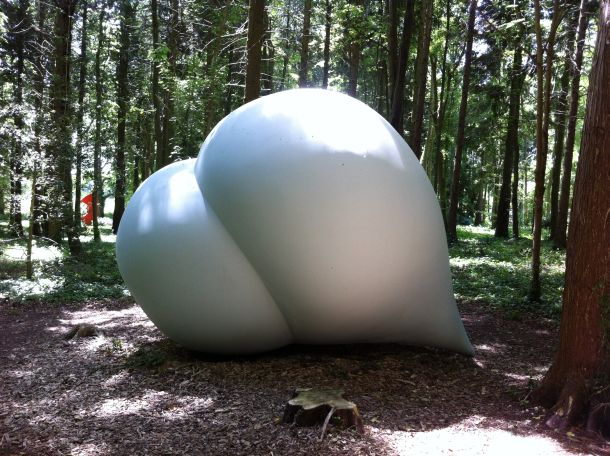
Host
Peter Burke Host 1996

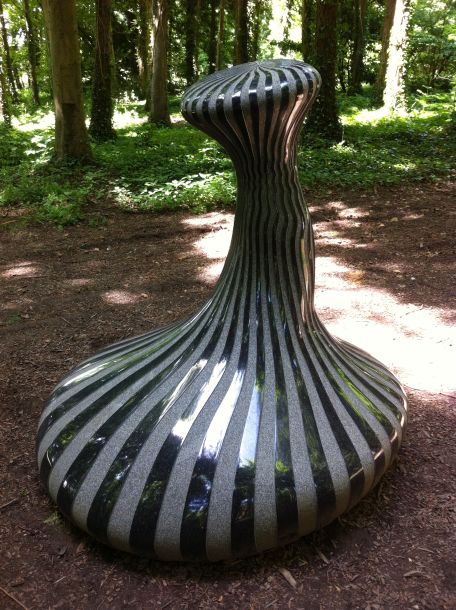
System no. 19
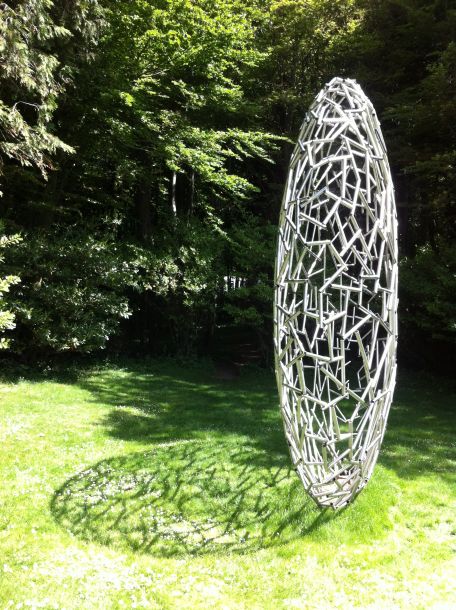
Julian Wild System no. 19 2007

Stairway
Danny Lane Stairway 2005

Singer of tales
Jon Isherwood Singer of tales 2010

Ace of diamonds III
Lynn Chadwick Ace of diamonds III 2004.  Both the larger and the smaller pieces of steel swing on pivots in the wind.

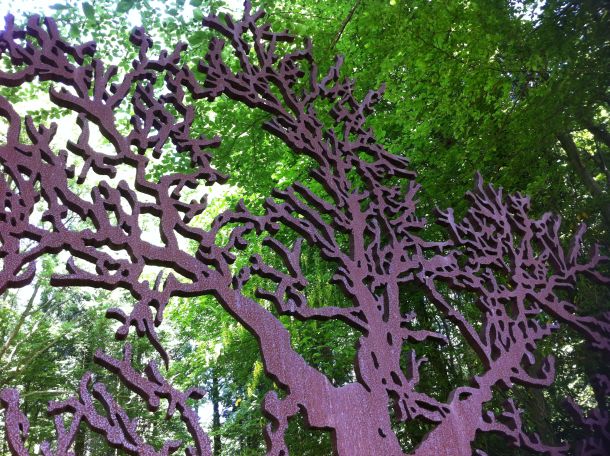
Exotic tree
Zadok Ben-David Exotic tree 2010

Picnic grove
David Brooks Picnic grove 2012

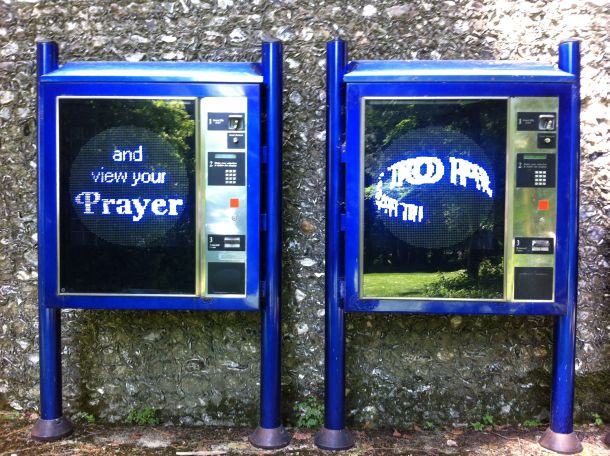
It pays to pray
Rose Finn-Kelsey It pays to pray 2001

Polar bear
Ellis O’Connell Polar bear 2008

Janus head
Peter Burke Janus head 1999

London-Paris
Eduardo Paolozzi London-Paris 2000

Pavillion
Alex Hartley Pavillion 2000.

All photographs taken at the Cass Sculpture Foundation, Goodwood, West Sussex, June 2013.


5 Comments

Wild blubbery aliens

We heard about them from the man in the hut serving a huge old wind pump once used to drain the Broads; one of those people who vocalises everything they think. On the last day of the holiday we parked up again by the pump and walked in rain for nearly an hour to reach the spot on the coast he’d described. I don’t think my daughter really believed there would be that many. But then neither did I.

Grey seals

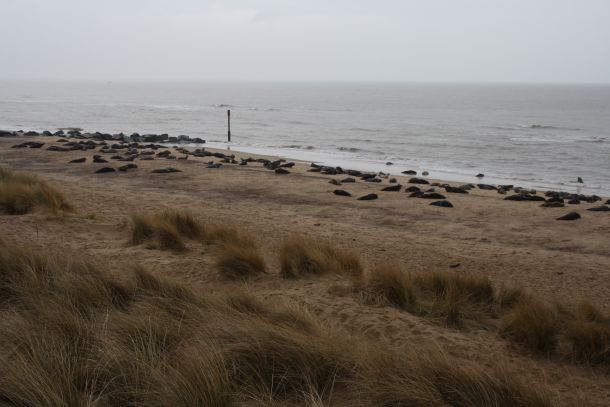
We breasted the dunes and looked down. From that distance, if you stumbled upon them without knowing they were there, you might think that they were rocks, because they blended in with those which form the groynes on this quickly eroding coast; and perhaps because they were lounging post-prandially, there wasn’t a lot of movement. 300 grey seals, actually a variety of colours, spread across four sections of beach. An amazing sight. Carefully we edged to within about ten metres. Any closer and they lumbered nearer to the swash.

Grey seals

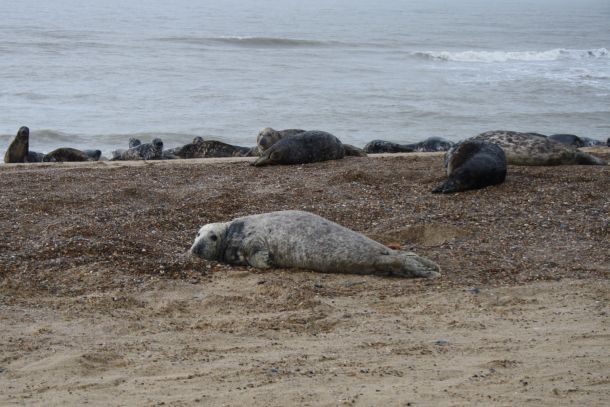
Seals are strange creatures; fatty blobs on land, swift and true in water. Though the grey’s scientific name Halichoerus grypus translates as ‘Hooked-nosed sea pig’, there was something canine about them; they seemed both alert and inert at the same time. They didn’t make that ‘arf arf’ circus seal sound, instead producing more of a keening ‘oooo’, which I imagine translates as ‘mate, watch out for that slim, shifty camera-wielding biped at five o’clock from you’.

Greay seals

My previous sighting of seals in the wild consisted of a single bewhiskered pinniped swimming close to a jetty in St. Ives. I never dreamt of seeing 300 together so close to human habitation. My daughter was thrilled. For once, on a walk, we had delivered the pot of gold at the end of the rainbow.

Grey seals


Leave a comment

Glass-bottomed boat

Amphora

Tanned and muscular, Mario could not have been more Greekly masculine; but he was infinitely patient too, and his boat was glass-bottomed.  It allowed you to see what would otherwise not be seen, down to the depth beyond which the human eye could not penetrate.  Through panes which light and water rendered jade, I saw starfish, octopuses, loggerhead turtles, a mysterious underworld of shoaling and sand and rock and weed and murk.  The prism of the glass was our fish eye, and we were an underwater creature with an excess of limbs.  When I raised my head I saw Ionian blues and sun-baked land and cliff faces carved into irreproducible forms by wind and water.  In their lee we dived and swam into caves lit from below by the sun striking through the water to reflect off white sand.  Mario’s boat took us places we would not have otherwise gone.  From the depths he retrieved the handle of an amphora, unseen by human eyes since the time of the gods.

Looking through the glass, I thought of Momus, the god of raillery and mockery, who wanted windows set in the breasts of men, the better to see inside their hearts.  If I wasn’t already awildslimalien, I might have called this place Glass-bottomed boat.  For here is where I lay open my heart and let you inside my mind; where also I try to see inside the breasts and foreheads of others.  Of course I can’t see inside of everyone; I’m no Greek god.  But if I have anything of a gift for seeing where sight alone doesn’t take you – into the idiosyncracies of the relationships of others, across boundaries of sex and species – then I feel I should make use of it, and give back what I have been gifted.


1 Comment

The o in Volterra

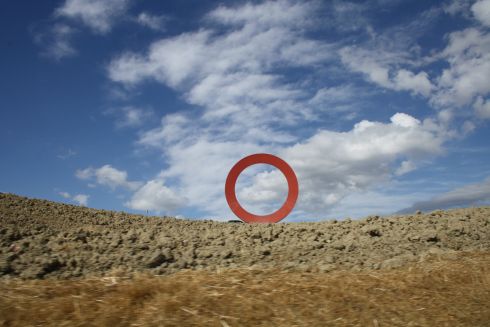
It’s on a hairpin bend as you drive west on the R 68 towards the outcrop of alum and alabaster upon which the town of Volterra sits.  The photo was taken from a moving car – a hairpin bend is after all not a point on the road which invites you to get out and set up your tripod – and much to my surprise, it’s come out almost perfectly (the roof of another car on the other side of the bend being the chief blemish).

A little bit of search engineering tells me that it’s Anello (Ring) by local born sculptor Mauro Staccioli, and just one of a number of pieces placed in the landscape three years ago.  It certainly beat seeing yet more of Anthony Gormley’s remorselessly advancing and rusting iron men in San Gimignano.

The landscape surrounding Volterra seems pale and a little eerie; Tuscan greens and golds blanched till they begin to resemble a moonscape in the white light of the afternoon sun.  That only adds to my feeling that Volterra would make a great name for an alien planet and species.  I imagine Volterrans being a flight of humans originally from earth, exiled millennia ago and evolving according to the terrain and the gaseous nature of the planet that they settled on.  Now they are ready to take back what’s theirs from the evil genius’ metal zombie master race currently presiding over earth.  We can only hope they are victorious.


2 Comments

Great glass elevator

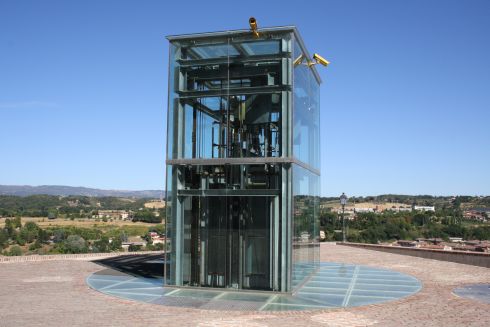
Colle di Val d’Elsa is a rather prolix name for a town, don’t you think?  And it turns out to be a somewhat elongated place too, being split into new town and old, the latter high above the new on a long, narrow peninsula of hill.  On the map we were given was marked a lift – ascensore – obviously for the purposes of getting up to the old town.  So we went looking for it and found instead only a steep incline folding back on itself as paths or roads tend to do when they ascend hills, and began to suspect ourselves the subject of a tourist-oriented joke.  It was only when we got to the top of the hill that we found it, landed like Charlie’s great glass elevator at the centre of a viewing platform looking down on the new town.  It seemed obvious to take a trip back down to find out where the lift came out, and how we had missed it.  So we did, and it was the strangest journey by lift I’ve ever taken; you go from bright sunlight to subterranean gloom, emerging at the bottom into a caved-out tunnel in rock, as cool temperature-wise as it had been hot in the open air.  The street entrance was unobtrusive, but the real reason we missed it was because there were two lift icons on the map, down below and up above, and – guilty of thinking that a map has three dimensions rather than two – I had guided us towards the up above icon without noticing the down below.  Fortunately I was quickly forgiven by the members of my party, on account of how truly peculiar the lift is.  Not to mention how sleekly cool, how other.

The old town was worth the climb, and the expense of the recent installation of the lift.  Two or three parallel streets run the length of the narrow hill, past churches, crypts, and crumbling palazzos; through shaded squares in which to sit, drink and gaze down from the hill or at the people passing through.  The founders of these old Etruscan towns chose their hills wisely and later inhabitants fortified them well; but I bet even then they wished there was a quicker way up and down them than by foot or horse power.  Well, now there is.


Leave a comment

In detestation of a barbarous Murder

A3

Former path of the A3 at Hindhead between London and Portsmouth.

The sailor's stone

The Sailor’s stone, with the former path of the A3 visible to its right.

Celtic cross

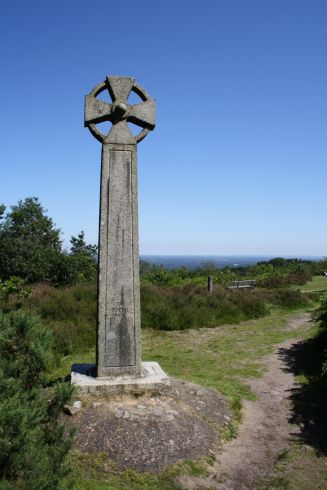
The Celtic cross on Gibbet Hill.  From here on a clear day it is possible to see major London landmarks approximately 40 miles away.

Temple of the four winds

Plinth of the Temple of the Four Winds.