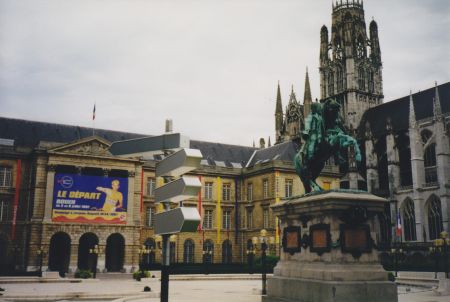
Le départ, Tour de France, Rouen, 1997.

Le départ, Tour de France, Rouen, 1997.
With my onboard boiler, I was forever overheating, especially now it was summer. The only way to stay sufficiently cool was to lie still, or as still as possible when a new life was beating a tattoo inside you with its possibly alien limbs. Or beating its future wings. I lay on the bed listening alternately to the music of and in my body and music played into my ears. Potting was by now beyond me; occasionally I sketched. My subjects were the coastal shack where I sometimes worked; its shape and how it was set into the fall of the land towards the sea were as familiar to me as the hands I put to work there. Or I would draw the wild slim alien as he sat on the bed against the angled ceiling of the room. Or Rupa, when she brought me iced drinks or an ice pack and stopped to talk to me.
She never asked me about the alien and what I really thought, but sometimes I would find myself talking about him to her, and then, just occasionally, I thought I could see hunger in the set of her mouth, however hard she tried to displace it with the curl of a gently sceptical eyebrow. The alien when he came up brought no offerings but instead – possessor of my body – felt for kicks, felt my breasts, marvelled at how hot my forehead was, brushed hair away from it, and otherwise did his best to make me both irritable and full of heart. When I shooed him away I immediately wanted him back. He was in one of his nervous phases again. At first I though it was the proximity to fatherhood, but then I got to wondering if it was something to do with Rupa.
Both of them were creatures of discretion; usually they could marshal an internal emotional explosion without it registering on their faces. A tightness around the mouth and eyes gave Rupa away, while the alien’s gait assumed an extra awkwardness as he stood braced against the wind of feeling, wind he could master gliding through the air, but not on the ground, earthbound. I began to sense that something had passed between them, but I would never be sure what. Just a few weeks from bringing a new life into the universe, I wasn’t going to let myself be dragged under with anxiety about it. People made their choices good and bad, but I knew I would go on with or without them, even with a broken or hardened heart. I’d done it before. And a baby only multiplied that. Made the breaking or the hardening less likely.
And then where one day there was tension, the next it was gone. While I was confined, they must have reached an understanding. If they had acted on attraction, I was sure I would know. I would feel it. I knew the signs, after all. Even if one had made an attempt and the other repelled, I would know. You can’t disguise that kind of awkwardness between two people. So when I saw them together, more or less at ease, I reckoned they must have talked, and one of them must have had the sense to rationalise the situation. Deflate it. I doubted it was the alien – he had a system of logic, but it didn’t apply to him personally. He went with the tides. It was part of what I loved about him. He gave himself the wrong name when he baptised himself Bill. William, well alright. Or maybe Daniel, from the surname he had spontaneously coined when the paramedics queried his name. Though that would have made us Dan and Chan, and we’d have had no peace from Sandy when we presented ourselves together at his bar.
‘What are we going to call the baby?’ I said as he sat on the bed one day. Curiously this was a conversation we – an atypical human-badezoid couple, after all – had not yet had.
‘I remember so few of the names we called ourselves. It’s one of my blind spots.’
‘But you remembered about the Gedavippio and the Peldastiquon.’
‘Through fear, I guess. Once encountered, never forgotten.’
‘Well, obviously we don’t want to call him after those bird-murdering bastards, if he’s a boy. That might be a little too destiny-shaping.’
‘It would be good to have one human name, one Badezoid. I keep trying to remember – my mother’s name, my own.’
‘Ah, if I could only remember my name.’ He didn’t like to be teased, but if he was so good at irritating me, I didn’t see why I shouldn’t have fun with him from time to time. He was a long way from fully appreciating earthling humour. We knocked some human names back and forth for a while. Then I decided to set him a little test.
‘Perhaps, if it’s a girl, we should call her Rupa. That would only be fair, after all she’s done for us.’ That set his frame rigid.
‘Okay,’ he said, uncertainly. Sometimes he was so guileless he was unreadable.
I didn’t blame Rupa. I didn’t think she would ever have set out to ensnare him. But somehow she managed to be both self-contained and softly magnetic and at close quarters I would have to say that I too was a little in love with her. And I knew her curiosity might be aroused by William – whose wouldn’t by a giant shaggy Australian who was convinced he was from outer space? And that her implacably stoic nature might be ruffled by proximity to him. But I don’t think even in our great need of her help that I would have invited her into my house if I could trust her. I just wasn’t that intent on self-destruction.

Barcelona, 2010.

Barcelona, 2010.

Paris, 5th arrondissement, 2010
Increasingly Chan was tired now, and wanted only to lie in bed or on the sofa, and read or watch television. While Chan slept or dozed I was thrust more into the company of Rupa. Worried that the growing life inside Chan might be making more demands on her human physiology than she could bear, I asked Rupa if she was at all concerned by Chan’s exhaustion. Rupa was typically perfunctory. ‘No, it’s normal that she should want to rest as much as she does.’
I realised that I was not sure whether Rupa knew I was Badezoid. Chan must have told Rupa, I reasoned, in order to make her understand why the authorities could not be involved in this birth.
‘Chan has told you about me, hasn’t she?’
That slow, quizzical look, the very model of noncommittal.
‘That I’m not from this planet. That I’m an alien.’
‘She told me that’s what you believe, yes.’
‘She believes it too.’
‘Does she?’
‘Yes, of course she does.’ A look at me, a beat, a look away. Rupa knew that withholding words was far more powerful than giving voice to them.
‘We’ve talked about it many, many times. I’ll admit that at first she wasn’t convinced, but she knows so much now, about my past life, since my memory’s returned. And why would she swear you to secrecy if she didn’t think that the baby inside her has a highly unusual gene pool?’
‘Why indeed.’
I could have begun in on the long descriptions of Badezon that I had given to Chan, but I knew it would be a waste of time. Rupa didn’t think I was an extra-terrestrial any more than she was. She, however, did not seem especially human either.
Yet I often found myself drifting into the room in which she was sitting. I watched her read, and waited for the glimmer of gentle amusement which momentarily curled up her lips at their ends. I interrupted her to ask questions about the birth; was there anything I could do to be more than simply a support?
‘If we need to ring for an ambulance… that will be your job.’
It was when one day I interrupted her reading for a fourth time, ambling backwards and forwards across the floor before the armchair in which she was sat, that she said, ‘why don’t you go out for a walk?’ There was as much amusement as impatience in her tone.
‘Why don’t you come with?’
We dropped down the hillside and threaded our way through the dunes and onto the beach, and into the last light of the setting sun. It was a still evening; the clouds were was hazed with golds rather than pinks. Before we left Rupa said to bring some newspaper. I carried it under my arm as we walked, never quite side by side, saying nothing.
It was low tide. She walked to edge of the water, obeying the drag of the moon, the backwards drag of particles by each successive wave. She stopped, and I turned towards the dunes and the houses to reckon. ‘It was about there, where you’re standing, that she found me. The day I fell to earth.’ I thought then that I saw just a little crack in Rupa’s sphinxy façade.
We walked further along, skirted the rocks of the headland and found ourselves in a bay that it would be tricky to escape when the tide turned and came back in; there was a way up the cliff, but in the dark, without a torch – without wings – it would be tricky. Under the lee of the cliff she stretched out a hand for the newspaper and told me to go and search for driftwood. By the time I came back she had found several pieces herself, had somehow splintered and arranged them pyramidally around the paper. From her pocket she produced a lighter and set the paper aflame. We sat down and she tended the fire periodically, adding bigger and bigger pieces of wood. We sat watching the flames, from time to time passing the small bottle of water she had also brought.
‘Who are you?’ It could have been either one of us who said it, but it was me to her.
She smiled a defensive smile. ‘I am Rupa. That’s really all you need to know.’
And I could not tell her my true name back, for it was the one thing that memory had not returned to me. Instead, on an impulse, I put my hands into the black nest of her hair and looked into her face. I wasn’t sure whether I wanted to shake her out of her ever-present serenity, or kiss her, or both. But I could make out no disconcerted ruffle, no invitation. Just a searching look back, an apparently non-judgmental appraisal. Perhaps kissing her might do it. I became aware of the feel of her hair in my hands, its thickness surprisingly soft; hints of its natural oils shuffled the sea smells aside for a moment. Reluctantly, gently, I withdrew my hands.
Then she put a hand to my face, brushed hair away from it. ‘I think we both would like to. But we both should not.’ It was the most demonstrative thing I ever heard her say.
We sat awhile watching the flames as it grew dark and the driftwood crumbled to white ash. With a start we realised that the tide was well on its way in and had cut off our route back round the headland. We would have to brave the cliff face. Rupa filled the bottle with sea water and poured it on the remnants of the fire. In the increasing gloom we found the steps shaped into the rock, and helped each other up them. By the time we made it to the top, we had reached an understanding.
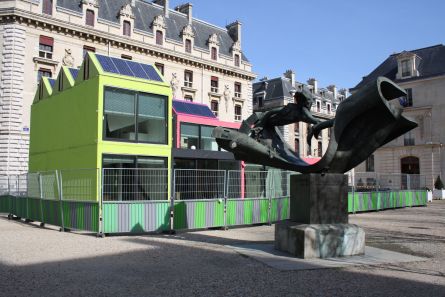
Paris, 4th arrondissement, 2010.
In sculptor Jean-Robert Ipoustéguy’s vision, Rimbaud, ‘L’homme aux semelles de vent’ (‘The man who strides the wind’), becomes ‘L’homme aux semelles devant’ (‘The man with his feet in front’).
It’s Good Friday-the-13th. Things between us are healed as much as they’ll ever be. We’re at Hampton Court. I’ve never been before, though Dad and I used to drive past on the way up to the warehouse at Putney, and he’d say, ‘we’ll go there one day.’ So it’s her place. As its courtier, she shows me round. The topiarists have made perfect cones of the yews before the Palace. We peek our heads inside, as far as the point beyond which you have to pay. She’s a low-ranking courtier, and I’m lower still, a clerk or secretary perhaps. The maze is out too, though I like to imagine ourselves lost in it. But we’d need to be several shades richer, or at the beginning rather than the end of the affair. The vine is free, though, and goes on forever.
After the gardens, we walk in a dip in the park. We guess it once was water. Walking towards the Palace, we happen to see a Royal mistress looking out from the open window of a first floor room. She starts as she sees the disconsolate of the future walking in the water. She stares a while, then turns away and slips into the room, there to wait on His Majesty’s pleasure.
Lone antlers of Hampton Court deer poke above the ridges, sheep abreast of them eye us disinterestedly. It’s then that we see it – the line in the sky, from the sun to the ground. A cloud has so trapped the sun’s light that it shields a perfect triangle of intense blue-grey, above and to the left of which is bright white sky. The triangle holds for a second, then begins to break up, the hypotenuse tilting upwards like a seesaw balanced then weighed down at one end.
The sky darkens to the west, where the line was, above the Palace. The sour yellow-grey of a thunderstorm approaches. It’s six o’clock. I have a stitch, she is such an indefatigable walker, but I manage to resist saying something about it feeling as though someone’s stuck a spear in my side. That’s very unlike me, to resist a wisecrack. It wouldn’t have mattered where in the affair we were, she’d have looked grimly upon me for it; but particularly now. I think of the sideways glance and wry smile she might once have gone on to give me, back at the beginning, her small, sallow face framed by that thick mass of honey-brown curls, and my ribcage is hollowed out by spear thrusts.
The thunderclouds rush overhead, and sunshine restores itself in the western sky. We are walking through Strawberry Hill and about to part forever, I back into the monotone of suburban routines, and she back into town for Easter alone, when we sense a rainbow is set to appear in the east. And Friday-the-13th notwithstanding – she sees it first, there it is. The rainbow arches full for us, or against us. Brightly, and then its inverted twin appears, stretching higher, more faintly, fading into nothing.


 A wild slim alien