
West Dean, West Sussex, 2008
Dust as we are, the immortal spirit grows
Like harmony in music; there is a dark
Inscrutable workmanship that reconciles
Discordant elements, makes them cling together
In one society.
– Wordsworth, ‘The prelude’

West Dean, West Sussex, 2008
Dust as we are, the immortal spirit grows
Like harmony in music; there is a dark
Inscrutable workmanship that reconciles
Discordant elements, makes them cling together
In one society.
– Wordsworth, ‘The prelude’
Rupa’s presence allowed me licence to fly more frequently, and for longer, now that it was spring, and for that I was grateful. I did not know what to make of her. She was an entirely different kind of human being to Chan – in looks, in speech, in what could be perceived of her thinking, everything. She was easy to understand but difficult to know. She seemed to lack something that Chan had – some basic but extremely sophisticated human facility to appeal – and in that sense, she was more like me than either of them realised. You will laugh when I say that she seemed alien to me. There was no attraction, at first, in either direction, of that I am sure. Despite the curiosity aroused by being at such close quarters with a second human, I swiftly came to resent her presence as an intrusion on the state of balance Chan and I had struggled so hard to achieve. It had taken me so long to adapt to the uncertainties which stemmed from being memoryless and fallen to earth, and for the two of us to stabilise the lows and highs of my sense of loss and the freedom that followed into something resembling a sustainable future.
No longer could we entwine our legs before the night-time fire; at least, no longer could I feel comfortable doing so, with Rupa sat in the adjoining armchair, sphinxing the room, unsettling me while she put Chan at ease. And instead of listening to Chan’s music, we watched earthbound television, and I failed to see there the poetry that I heard in the earth’s music. Chan and Rupa laughed at the inanities and frivolity, and laughed at me for not laughing. I slammed the door as I left for my shift at Sandy’s, and when I returned Rupa was sitting where I usually sat on the sofa. She was feeling Chan’s bump, smiling with silent, sphinxy joy at the feel of the wriggling feet. The television no longer played in the corner. I wondered how long they had been sitting like that. There was nothing calculated about the way Rupa ignored my presence and continued to fondle Chan’s belly, but there was enough in it to suggest a notion to me that I had not previously considered. I brooded on this notion as I sat in the armchair and ate some cold pasta. In my head I sang an old Badezoid flying song to blot out the exclamation of endearments that my child’s every kick brought from the two women. I finished my functional meal and gradually then I calmed down. (Sandy had earlier remarked what a furious pot washer I seemed to be this evening.) When Rupa offered me back my place on the sofa, I softened and waved her back into her seat. Then Chan smiled at me and we were all at peace. That is, I became part of the peaceable scene that existed before I walked in the door. Gnawing resentment was my cross to bear, mine alone.
Because even within the privacy of our bedroom at night, things were different. Chan wanted to make love less frequently now, and when we did, the wild abandon which had been so confidently ours was now diminished. When I cried out in Badezoid tongue she cupped my mouth for fear of Rupa hearing, and her own moans were self-stifled. We arrived at the same destination, but the journey there was frustrating, stop-start, a mimicking of past couplings. It was odd, for Rupa was a woman of women; she knew their bodies and their needs and surely would not have been surprised to be woken in the night, nor minded.
Increasingly of course there was a fourth member of the household to consider, and its needs were fast becoming paramount. But I understood that and would not mind it. I could feel the engine of history powering up behind us, inaudible at present to all but ourselves. As far as I knew, we were the parents of what would be the universe’s first human-badezoid child. The more I dwelt on it, the more I could not wait to watch over this little one until its fledgling wings were strong enough to bear a grown body’s weight into the air and away beyond my sight. I did not fear that it might turn out to be the true sphinx, a winged one, part human, part lion, part bird, unknowable even to its parents; its unique thoughts and destiny unguessable.
And so Rupa and I sat at breakfast and in the evenings as two inscrutable statues, one wearing a mysterious smile, the other a slight but unmistakeable frown. Between us, exhibiting the supreme rosy glow that was the gift given by a unique interspecies incubation, sat the woman within whom the little sphinx grew, the woman we all needed and who needed us.

Spinnaker Tower, Portsmouth, 2009.

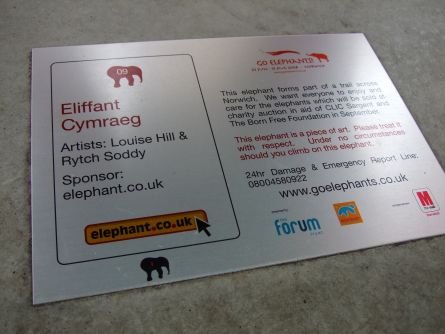
Norwich, 2008.
On subsequent nights in dreams I would find myself alone in the earth of Earth, panning for gold, picking out aurous fragments, flakes, seeds from gritty, water-trickled alluvium. Then suddenly – gloriously – a fragment became a whole sheet of gold foil, on which I tugged to free it from the disrupted reddishness of the river bed. Now I was aware that all around me there were many, many other tabs of gold on which to tug. So I pulled at them too, until the sheets were piling up beside me, stacked like material in a draper’s. Then came the feeling of people as yet unseen ominously starting to gather around me; hard people with pioneer faces who would do me harm and take what was mine. So I tried to pull my gold faster, but now it would only come more slowly, and my mind was not on the beauty of the gold and the excitement of freeing it from the earth but on how long I could leave it before I would have to run to escape with my stack of precious cloth, and my life. And when the moment came and I ran – ran like the wind – the sheets blew from my grasp, and I was left with just one. I stopped and from a distance watched the hard people tear the other sheets and themselves apart. I calmly folded my gold into smaller and smaller squares until it resembled a handkerchief. I pressed it to my cheek, then placed in my pocket, and walked away.
On other nights still I dreamed of Dancing Ledge where I had once twirled alone, the only creature alive under the sun, or so it seemed that fine May evening. But now in this dream I was standing on the edge of a pool carved not out of the ledge itself, but the quarry behind, a nightmare blowhole of muddy quicksand, a plugless sink into which I would be sucked if I fell into it. I teetered on the brink in the strong westerly, and waited for the wild slim alien to fly in and rescue me. And waited and waited and fell and woke. Beside me he slept on, his dreams sweet now while mine had turned sour, disturbed, filled with foreboding.
I was beginning to see that I might need more support than he could give if I was to get through this pregnancy and the birth without involving the matriarchal hand of the health service. There were ways in which he could calm me, but in a crisis he could not be relied upon to remain calm himself. In a place somewhere near where the baby would kick me for the first time, I knew our paradisiacal state would not last. Perhaps life had rendered me a pessimist, a fatalist who expected pain and loss and death. I needed someone who would break my fall, when the time came, however it came. Because whatever happened I was sure I would need to continue to place one foot in front of another, continue to draw breath, for one being’s sake or another’s.
The choice was obvious. Her name was Rupa and she was steady, faithful, the only friend from the city where I had lived who kept offering me her ear and her shoulder when everything I touched was curdling, and I was habituating myself to death and loss and pain; all my other friends were driven away. She had black hair that flew away from her face in unruly curling bunches – luxuriant and ludicrous all at once so that I sometimes had to restrain myself from plunging my hands into its midst for the pure joy of feeling its texture and weight. Her nose was sharp and larger than proportion demanded but that was all; she was closer to beauty than plainness, and she never seemed to age. Her skin had remained as healthy as her hair and her smile was an optimist’s, seemingly untainted by any measure of pain she may herself have had to swallow in her own life. And – crucially – she was a doula. I invited her to stay. She accepted. That was how I explained our need of her to the wild slim alien – that she knew about labour, and birth, and my needs. If we were going to do this ourselves, we needed a third person we could trust.
We had already decided to avoid the usual scans. I would not be sorry to miss the first official staging post, given what that scan had revealed in the past. So weeks thirteen and twenty came and went without the authorities being informed that a new life – and possibly a new life form – was as yet unaccounted for.
The alien hovered by the door waiting to be introduced when Rupa arrived. I hugged her, and felt that mess of hair against my cheek, and promptly burst into tears. The baby kicked and the alien hopped from foot to foot as Rupa calmed me, rendering him surplus, and (I could tell) a little agitated by the wait before the formal introduction was finally made. At that moment and ever after, neither betrayed anything about what they made of the other. So now I had two people living in my house whose respective thoughts I would always be hard-pressed to guess. But I needed them both.
Winchester, Hampshire, 2010
His answer left me not much the wiser.
‘Well, there’s an exoskeletal formation on each shoulder which protrudes from what you call the scapula. What in a free translation from the Badezoid we might call the ‘oriel’, as in the protruding window. Let me feel yours.’
He reached over and put his long arms under my top, feeling the shape of my shoulder blades, and tutting in a way he’d picked up from Sandy as he presided over his optics. Just as I was relaxing into the connection that was being established between skin and sleepy brain, he stopped as abruptly as he had started.
‘Your scapulae are disguised by all that potter’s wheel muscle of yours. But in the bar and on the beach I’ve noticed that many humans have quite pronounced or pointed bone structures there, which are not dissimilar to the Badezoid child’s. I think there might be a genetic relationship between our species that is lost in the mists of time. That is of course something which could now be tested.’
I gave him a ‘we are not submitting ourselves to tests’ look.
‘Anyway, the casing of the Badezoid’s fledgling wings is embedded in the scapula and is not necessarily that much more pronounced than a human’s, though inevitably Badezoid shoulders develop more powerfully than yours’.
I though about mentioning Björn Borg at this point but the flippancy would almost certainly be lost on Bill. I was by now inured to human inferiority and Badezoid superiority. Besides, it was flattering to hear that my shoulders disproved the general rule. At least, I think it was.
‘It might look a little odd if the baby does carry the genetic coding to develop wings, but if it did, the protuberances could still be in the spectrum of what is humanly possible and explicable. But the ridges might raise some eyebrows.’
‘Ridges?’
‘Badezoid babies have a ridge along the underside of each arm, from which an additional part of the wing structure sprouts at a varying age – the shoulder wings overlap with these so that the arms become part of an impervious whole. If you look along my arms you can just make out the scarring where mine were cut away. In places.’
I peered at his now wingless arms, raised nevertheless as if for flight, and looked for seams as you might in the stitched-up sides of an ancient teddy bear. It was difficult to see by lamp and flame alone, and I was too comfortably heavy to get up and turn the main light on. I made a mental note to check on another occasion, but I’d made more than one thorough exploration of his arms before now, kissing the length of them, and not noticed any ridges. I trusted my lips as much as my eyes in that respect.
What a strange state I was in. Pregnant by a man who genuinely seemed to believe he was an alien, and against all rational analysis instinctively inclined to give maternal credence to the notion that my baby might appear from the womb with a pair of wings. It was as if in taking his seed into me I had out of reproductive necessity become part-Badezoid myself.
Was this the birth of a new species, a story that would one day be embellished to become a set of magnificent fables – a creation myth – or simply a series of delusions told by a madman and believed by a woman not much less insane, day after deluded day? That I still did not know; I believed he wasn’t entirely sure either, or that the baby when it came would offer us proof one way or the other.
My dreams that night defied rational analysis too. As dreams should; but these were such as I had never had before, going beyond those I remembered from my previous pregnancies, before each successive would-be life was unfairly, harshly snuffed out. I dreamt of walking with Bill through what in the dream and on waking I knew was a forest on Badezon; the scale of the trees was unearthly and their unfamiliarity magical. Badezon appeared as a deserted world in which the alien and I roamed together, as if we had been given the planet to populate. The wild slim alien’s wings were spread like a cloak around my shoulders as we drifted along a short distance above the sandy forest floor. And the love we made hidden among waterside trees that bore some resemblance to weeping willows woke me with a start. For a moment the vivid reality of the dream took away my breath, and the whole of me heaved with waves and wings of desire.
I waited for her to tell me. On Badezon a male of the species knew when the female to whom he had become attached was expecting a child; there was something in our biological make-up that made it so – a smell, a look, a difference, a genetic understanding. I presumed this was not how it was with humans. Typically their biology seemed to breed mental complications where ours stripped those complexities away, rendered them simple. But I judged it best not to let on that I knew; I suspected it would – in a phrase I heard regularly among hang-gliding club members – freak her out. In the meantime I tried to work out the implications of the as yet unspoken news, and to translate my instinctive Badezon reaction of joy and deep curiosity into some gently equivalent human male form. Humans seemed to think that the gulf between their sexes was wider than it appeared to me to be, but perhaps the margin was most frequently at its largest when the half that were men were faced with the struggle of making the transition between partner and parent. The little that Chan had told me about her previous partner seemed to confirm a male fear of being shaken out of a comfortable rut into one which he envisaged being both less comfortable, and less free.
We were sitting before the fire one night, watching the flames dance awkwardly to some of Chan’s favourite songs. When the music stopped, a raging winter wind stepped in quickly to take its place, howling its frustration at not being able to blow our house down. Chan took my hands and I knew this was the moment; I knew the words she was about to speak. She spoke them, a badly disguised look of uncertainty in her eyes. I smiled, and I kissed her, and, finding I was unable to pretend otherwise, told that I already knew, had known for some time. She hit me on the head with a cushion then, and said, ‘Why ever didn’t you say? I’ve been worried sick about telling you.’ Then she hugged me, and kissed me back. It was difficult to gauge, but I think my reaction had pleased her. She talked, slowly at first, then with her words tripping over each other in their rush to be spoken. I listened, smiling all the while, and looked into the heart of the fire just as ancient cave-dwelling Badezoid males must have at the blaze pitched in the mouths of their shelters, dwelling with primeval satisfaction on the knowledge that their line was set to continue.
My attention was drifting, so I made an effort to reconnect with what Chan was saying, and realised to my surprise that she seemed to be seriously countenancing the possibility that this baby might be born with an unusual set of genes. Not just a weird set, but alien. This was a breakthrough; but it was probably also a sign that Chan’s underlying pragmatic determination was coming together with the maternal instinct to protect her unborn child from every conceivably threatening possibility. She desperately wanted this baby, and nothing – not even alien genes – was going to stop the world from treating it like any other ordinary, wholly human infant. After so many disappointments, she did not want success to turn into a freak show. But it was what she asked me next that most confounded my expectations.
‘Are Badezoid babies born with little fledgling wings, or do they sprout from your shoulders at some point as you grow?’

Barge House Street, London, SE1, 2005
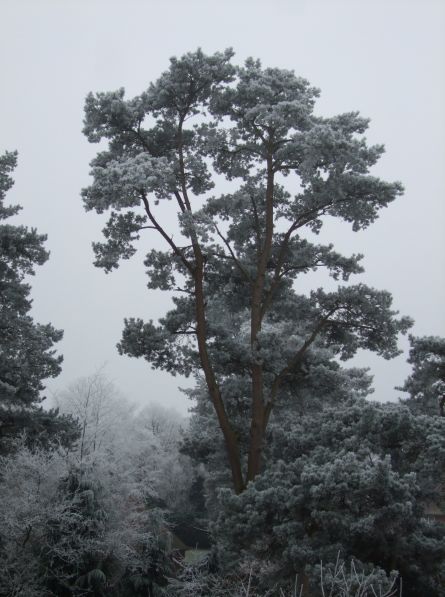
Scots pine, Hampshire, 2009.
 A wild slim alien