
My daughter is home and the work of the laundry has increased. Having run out of drying space, I hang a shirt from a print above the wooden casing of a radiator. Moments later, having left the room, I hear a crash. The shirt has fallen, taking with it a blue bowl which was standing beneath it on the casing. It’s in scattered fragments on the floor. Ostraca, with the writing erased. Immediately I know what I’m going to do. I gather up the broken pieces, and carry out some online research.
A few days later, two separate, inexpensive kintsugi kits come through the door. The first contains two small mint-green-coloured bowls, as well as a cloth bag, glue, powdered gold pigment in a plastic container much like you might have for eye make-up, and an instruction booklet. Kintsugi (golden joinery) or kintsukuroi (golden repair) is the Japanese art of repairing broken ceramics with a resin lacquer mixed with powdered gold or silver pigment. Philosophically, it conceptualises breakage and the ensuing repair as part of the ongoing life of an object; something to accept rather than hide. Says the booklet, ‘It is a manifestation of the principle of wabi-sabi, which teaches us to embrace and celebrate imperfection, impermanence and incompleteness.’
Unlike Nick Cave, I have no previous as any kind of ceramacist. I’m not an art school dropout nor indeed competent in any kind of art but the use of words. Yet this combination of salvage and careful craft appeals to the creative core of me, and speaks to the way I try to write.

The two small bowls allow a novice practitioner of kintsugi to learn the ropes. You must break them yourself, wrapping one in the cloth bag then smashing it against a hard floor (in my case the tiles of the bathroom). It takes me four or five attempts to strike the floor with the right force before the first bowl shatters. Besides successfully breaking it, my first attempt at kintsugi does not go well. I put too much pigment in the glue, and the bond I unevenly apply to the first two pieces using a mini-plastic spatula fails as soon as I stop applying pressure. I persevere, holding the bonds tight for the required minute, but in the process getting pigmented golden gluey fingerprints here, there, and everywhere on the surfaces of the bowl. And the golden joins are thin in places, ballooning outwards in others.
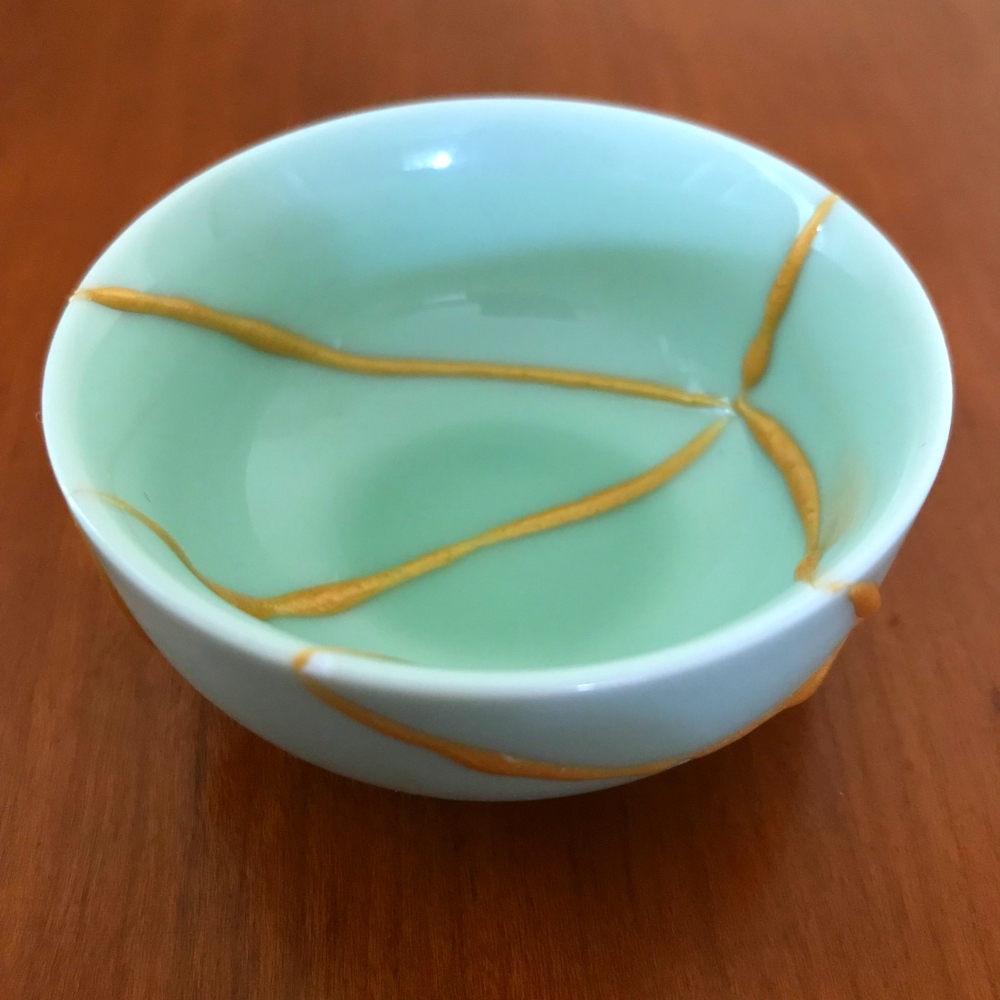
I re-read the instructions and fare much better with the second bowl by doubling the glue and halving the gold pigment. I apply this better-proportioned mix more evenly to the bone-white edges of five fragments. Not wishing the remaining glue to set hard on the mixing card, I pause little more than a couple of minutes between adding each fragment back to the puzzle of the whole, hoping that the pressure I apply won’t inadvertently loosen the previous joints. Thankfully it doesn’t, and I take my time mixing up some more lacquer for the final fragment before working swiftly but carefully to fit it into place. The end result surpasses my expectations. It’s a thing of beauty, a landscape traversed by rivers of gold. These seem painted onto the surface rather than joining the fragments together, while the colours – sunlight and the pale underside of a leaf – contrast and complement each other perfectly.

The large blue bowl I accidentally broke is a project on a far bigger scale, so I save that and the second kit for another day.
Possibly because of a song on Lana Del Rey’s 2023 Ocean Blvd album, or perhaps as a result of a shift towards sustainable living, not to mention the pandemic giving people more time to try it, kintsugi seems to be having a moment outside of its country of origin. The availability of such kits as I purchased suggests this (unless they’ve always been available), although even surface research into how kintsugi is practiced in Japan, where it has its origins in tea ceremonies and earthquakes – cracks in the ground – shows I have a way to go before I learn the more sophisticated art of mending breakages with tree sap lacquer and genuine gold powder rather than super glue and glitter. Lyrically Lana links it with Leonard’s famous lines from Anthem about how there is a crack, a crack in everything, that’s how the light gets in. ‘Then you’re golden,’ Lana quietly concludes. Light seeping out of a broken vessel. Hard not to think also of the golden-voiced Gil Scott Heron, sorrowfully singing about a broken father in Pieces of a Man. Artists show personal cracks through their work; but in day-to-day life, we all of us tend to keep those flaws or scars hidden as best we can.
Time to mend the bowl I smashed. The second kit has bigger double-barreled tubes of glue, and two small pots of gold powder. I begin by setting the larger pieces, as instructed. The first is a good join, fused with a nice thin vein of gold. The vein of the second is thinner still, but the join nevertheless holds after a minute of applying pressure. It’s only when I trial a smaller third fragment that I realise the second join is misaligned by a couple of millimetres, meaning that it juts out above the rim formed by the bigger pieces. I use pliers in an attempt to force the issue, clipping off fragments of the third piece in an effort to make it align. But all I do is create a bigger hole at one of its bottom corners. I will have to rebreak the second join, but now that is as firm as if it had never been broken at all. In frustration, I set it all aside, to try again another day. There’s no success like failure, and failure’s no success at all.
The self-application of kintsugi is a harder project still, an ongoing one, with results that are often as difficult to discern as the hairline cracks in ceramics when you fit fragments back together to work out in which order you should glue them, before applying golden joinery. The metaphor is obvious, yet nonetheless powerful for that. I got broken in childhood – the effects of a traumatic, violent divorce on a sensitive child at a sensitive age – and have had my fair share of breakages since. I’m in no way unique in this regard – the majority of us carry fault lines within ourselves, many of which date back to our early days. There are no doubt endless ways to heal, to learn to accept the cracks in your make-up. For me, writing is the way, and the result is a yet to be finished work in progress. Even if the words do not directly address the breaks and the flaws, they are nevertheless an engagement with the optimistic sense that what we create – individually and collectively – may last beyond the limits of our lifetimes. It might seem futile to create with that thought in mind, while there are far more significant global fissures in desperate need of political repair. But without art, there is no culture, and without culture, no connection of one mind to another. ‘Art is the pact of individuals denying society the last word,’ writes Rachel Cusk in her novel Parade. A force that binds those individuals – both creators and those who actively engage with them – together in opposition to destructive oppressors.
The pandemic was a collective break that we all of us experienced as a personal as well as a societal fracture. The mending is still ongoing; the UK enquiry, as well as being an audit of government policy and practice, a hopefully forensic search for truth, could also be described as an act of golden joinery. Elsewhere in the world, it’s long been clear that the current POTUS is by nature a breaker of both functional and precious things. After his second four years – should he and his billionaire acolytes be forced to relinquish their grip on power – decades and very possibly centuries of repair work will be required.
My own quiet, unobserved golden joinery will continue, come what may. Perhaps the work in progress that I am – that you are – will never be completed, but me being me, and us being us, we’ll go on trying.
 A wild slim alien