1. To more easily imagine that you are a character in Bleak House.
2. As winter warmers.
3. Come spring, they go very well with Fred Perrys.
4. As a late-blooming rite of passage, just when you think there are none left.
5. To save time shaving.
6. To diminish the size of ears.
7. To give the impression when wearing a woolly hat of having lots of hair underneath it.
8. To look out of time.
9. To have friends ask, ‘what’s with the lamb chops?’
10. To remind yourself in future years how much better it is not to sport sideburns.
Author Archives: awildslimalien
Plastic henge
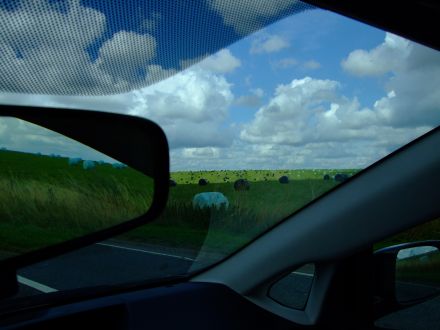
Wiltshire, 2009.

Kerplunk! – [The island]

You stare at the maps of home in the back of your diary, spending hours tracing the path of your life, circling out from a point on the fringe of the capital to a succession of dots within a fine web of country lanes on the flats of Suffolk, then plunging back into the heart of the City, shooting off like a cardiograph stimulated by palpitations for weeks and weekenders away. Plymouth, Nottingham, Exeter, Leeds and Brighton – all become connected – England as far apart as Amble and Penzance. You imagine some watcher over humanity tracing your whereabouts and movements on a large scale map, recording the circles and strange turnings and goings-back-on-yourself that you make during the course of a week or a year. You wish that your paths were as undeviating as those of aircraft lines across the globe, that the watcher over humanity might give you a few hints as to where you should be going.
Such a spirograph would also chart the M1 and M6 hitch into Strathclyde, the first leg of an eight day figure of 8. From the mileage chart in the diary you work out you fell just short of four hundred miles for the day. When you reached the club that night, in a little west coast town jutting out like a nose into the sea, you and your friend manage to clear the dance floor simply by taking to it, wild and unrestrained, misshapen, round pegs trying to fit into a square hole.
You travel between the twin sentries guarding the Highlands, Glasgow and Edinburgh, where, on a freezing morning, you kiss another friend goodbye, walk out of town and drop down to Stoke. There, with a feverish headache from want of warmth and food, you watch an early performance by the friends who are soon to come France, in the back room of the Gorgon’s Head. It is one of those seemingly carefree but charged early displays of their melodic manifesto, out of which they later gained recognition, and inevitably is witnessed by only a few people; the early days of a group when spontaneity comes more easily and self-belief pugnaciously, and it is freshness rather than success which inspires. Whether it’s the music or the spirits or an unsuspected reserve of energy, you don’t know, but your headache disperses.
Reaching Bristol the next day is easy, with your lift, a student farmer in a Morris Minor, taking you right into the city and over the antiquated, single lane, one way, roller coaster flyover. Touching down, you feed a score of swans with a left-over roll, in what you will later learn to call the Floating Harbour. Your trio of friends receive you enthusiastically in the city they’d set out to conquer, grateful for the impetus a visitor provides in the black hole of dole-time.
And so back to London, on a hitching high; with your City-mask not quite fully resumed, the tube journey home is taken in rare exuberance and a feeling of being above the City, impervious to its constraints and its customarily grim set. Once you are reassimilated, only weekend alcohol lets you laugh in the stony face of the weekly cycle of imprisonment which is the bargain London forces on you.
There is also an Underground map at the back of your little black book, around which you can catch remembered trains. On this graph within a graph, you chart hundreds of journeys into the centre with Louise, and hundreds more elsewhere and without her. You even have an enlargement of the West End and the City, to re-enact the dramas of couriering, exploration and drinking, in a spirograph of celebration and misery.
A wild slim alien
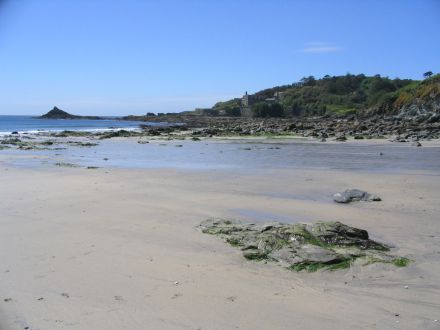
Cornwall, 2007.
The fugue state
It was when I put an exultant fist through one of the ceiling tiles in the room to which Chan and the baby had been transferred that the consultant told me to calm down. But he was barely calm himself, because he could see what I could see – that this was no ordinary human baby. The upper third of her musculoskeletal structure had significant differences to those other babies down the corridor on the maternity ward. Her shoulders were oversize, where in a human baby only the head is. Following the two scalloped protuberances down the baby’s back with an informed pair of hands, the consultant’s face showed constant surprise. Gareth’s professional coolness in the operating theatre in the operating theatre had been replaced by rising excitement that he had just delivered into the world an extremely unusual infant – possibly an impossible one.
Chan held the baby’s head to her cheek, kissed the covering of still wet hair, ran her fingers over her daughter’s wing stumps, all the while murmuring to her, while Rupa and I sized up Gareth, wondering whether we could trust him, whether we had now moved so far beyond trust now that we would need to do something decisive if we were not all to be turned into lab rats. – That was the phrase Chan had used, in fear of just this eventuality. Rupa nodded at me, confirming my own impression that Gareth’s elation was mostly down to the scientific wonder before him rather than contemplation of the prospective fame awaiting him. But inevitably those thoughts would soon run through his head. How would they fare against his duty to do what was best for those in his care? How quickly would decisions be taken out of his hands as word spread? How far would word spread, and how quickly?
Rupa took me to one side. ‘I think you have no option but to take him into your confidence. He may have enough clout to protect you all long enough for us to work out what to do.’
‘If he feels we trust him, he may trust us.’
‘Exactly.’
So I told Gareth that I needed to talk to him. Rupa stayed with Chan while I trailed the consultant to his office.
‘So, are you’re going to enlighten me as to how you believe your baby came by those strange shoulder formations?’
I told him everything, from the day Chan found me on the beach to the moment we presented ourselves in A&E. I told him about life on Badezon, and the fate I thought had befallen me. I asked him to consider my unnatural hang-gliding ability, though of course he only had my word for it. I took of my t-shirt and showed him the traces of the scars at my shoulders, where my own protuberances had been severed. Almost everything. I may have left out the part about me having come unhinged from time to time, enough to wave a knife in the faces of Chan’s innocent neighbours.
‘You’re an alien. From… Badezon?’ He couldn’t quite bring himself to believe it. ‘Have you heard of the fugue state? Retrograde amnesia? Haven’t you – not to put too fine a point on it – simply been acting out a form of ingrained psychological role play?’
‘So how do you explain my daughter’s oriels?’
‘Oriels?’
‘That’s what we call them – the shoulder protuberances. From which her wings will sprout.’
‘The wings you no longer have.’ I shrugged, and watched him mentally scroll through the possibilities, discarding each in turn. He knew none of them explained what he had felt under the newborn baby’s skin, and was sharp enough not to bluster me with the least outlandish of the explanations.
‘You must admit it’s a lot to ask me to credit. And that there are holes in your story, giant holes – you will say because of the amnesia, of course, I understand that. And yet… that exoskeletal formation at the shoulders; nothing else explains those except a genetic lineage not of this world.’ A little dazed by all he had seen and heard, he held his jaw in his hand, and I knew he was trying to think clearly and work out what to do next. I felt it might be best if I didn’t give him the opportunity to do so. I had noticed the camera on his desk.
‘Bring that. You should have documentary evidence. On the condition that you do nothing with it without our say-so.’ He looked in a draw, and eventually fished out a sheet of paper. Some kind of waiver.
‘No, I won’t sign that, not yet.’
I was dangling him the celebrity, if he wanted it, or merely the scientific kudos. Of course, if we disappeared off the face of the planet, it could turn out to be ridicule. I just hoped that he was unaware of any protocol within the hospital to deal specifically with any situation as unique as this. If we passed into government or military hands I feared for our futures.
As Gareth took photographs of baby and mother, Rupa and I stepped aside again.
‘How quickly will Chan be able to be back on her feet?’
‘Three or four days, if there are no complications. She’ll be able to move about – she should do so – but she’ll also need lots of rest.’
‘Rupa, nevertheless I think we are going to have to disappear. Otherwise our lives will no longer be our own. I don’t want our child to grow up in what would essentially be captivity.’
We had foreseen that the need might arise. We could not now go back to Chan’s. But Sandy, who rented out the odd property, had readily agreed to prompt a friend who was also in that line to set aside a safe house for us. It would buy us some more time. Not much, but enough to work out what to do next. But a lot could happen in the three days she was supposed to remain in hospital.
We would need to plan for a sudden discharge.
Confinement
I came in from my shift at Sandy’s less tired than usual. I had done very little flying of late. I knew Chan would not want me to be far out to sea when the time came. Quietly I went upstairs to see if she was sleeping. She wasn’t. In fact, unusually, she was lying against the side of the bed rather than on top of it. Her face was pale and drawn, and her voice when she found it was urgent.
‘I think it’s started… call Rupa.’ There was an edge in her voice that felt like a reprimand, for me not having been close by at the moment when she needed me to be. But it was probably just the painful peak of a contraction that made it come out so. ‘Now,’ she said, and that was a reprimand. I went across the landing and knocked. After a few moments Rupa appeared, in t-shirt and pyjama bottoms. She reeled off the list of things I was to fetch, which would not be difficult because we had set them aside weeks ago; Chan was way past ten months now. Rupa felt sure that she must have her dates wrong, but she and I were both sure that she had them right. She was overdue beyond the record books. The cross-breeding had to have resulted in a longer gestation period – not that I could remember precisely what that was for Badezoids, and so work out an average – but otherwise Chan seemed much as Rupa suggested was normal for an entirely human baby. No cause for concern. Chan wanted to believe her, but never having got this far with a pregnancy, she had no way of knowing whether or not her body was feeling as it was supposed to feel.
But when Rupa signalled that she and I should both duck out of the bedroom, Chan knew something was up. Rupa was perturbed that the contractions were not proceeding according to the book. ‘The timings are not as they should be; and now she is in more pain than she should be. I don’t feel confident about where this is going.’ We decided on wait and see, but if the level of pain increased, then I would ring for an ambulance. Through an undercover operation she and I had acquired certain painkilling pharmaceuticals, and one of these Rupa now decided to administer. Even though she was in pain, Chan was not pressing us to ring. I think she knew for sure now that what was inside her was not within human understanding, and she was determined that if at all possible her baby would not be treated as a freak. If we could get this new life out of her without medical intervention, that would be worth the risk.
The waiting grew heavy on us. All through the night, and till noon the next day. But I couldn’t leave her side, much as though she might have wanted me too, with Rupa there too, doing a better job of trying to make her as comfortable as she could. It was a hot, heavy morning. From the windows I could see that the sea was a millpond, and even with them wide open to receive such flutters of breeze as there were, the room was too hot. How much hotter for Chan? We gave her ice cubes to suck, and a towel dunked in a basin of ice water was at her forehead. For periods I held her hand; for others she shrugged me off. When such air as there was tickled at my nostrils, I drifted sleepily out of the room, letting myself be carried on my wings by a thermal, out above the sea, where it would be freshest. I hadn’t flown in weeks; I yearned to be out in my natural element, but I also wanted to be here, to do what I could, to carry on holding Chan’s hand through the pain and the effort and the waiting, to see our child, and, yes, I confess, to see whether the body of the brand new life form, covered in vernix caseosa, or its Badezoid equivalent, perhaps some alchemical mix of the two, presented us with proof of my story, with proof that on another planet, bipeds could fly. With proof that I was not mad.
My reverie was broken by Chan’s scream.
Rupa said, ‘Ring for the ambulance. Now.’
Le départ
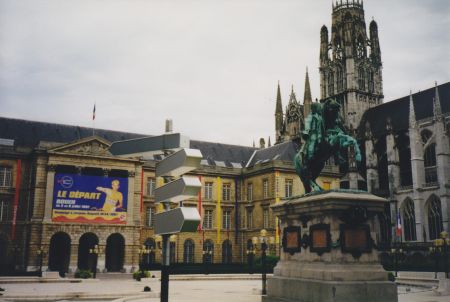
Le départ, Tour de France, Rouen, 1997.
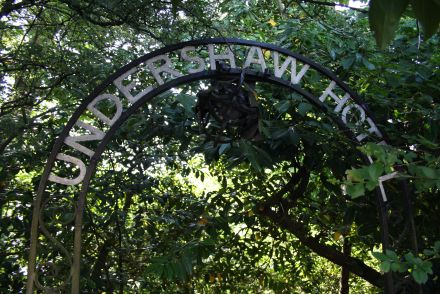
Undershaw

Sagrada Família

Barcelona, 2010.

 A wild slim alien