A wild slim alien


5 Comments

Jumping through hoops

The bombardment of Algiers

I am holding hands with two work colleagues, as part of a circle of ten. This is not something I am accustomed to doing. Over my wrist hangs a hula hoop (the children’s toy, that is, rather than the potato snack); on the opposite side of the circle another is similarly positioned. The object of the exercise is to pass the two hoops around the circle without any of us letting go of our colleagues’ hands. We are in competition with two other groups of ten and it’s as we stand there hand in hand waiting for the whistle that I wish I had played up my sore shoulder when the facilitator asked if anyone had a back complaint. But there’s no escaping the circle now, so I do my best for the team on each of three attempts. After we have finished second overall, the facilitator elicits from us the team-building attributes of this exercise. I expect you can imagine how facile the dialogue is. While it is unfolding, everyone is sitting around in a circle on the floor, some cross-legged, as if they were back in primary school. Everyone, that is, except me. I’m the one breaking with my team to sit on a nearby chair. The facilitator clocks me, has me marked. I am evidently not a team player. But if she’s thinking that, then she’s wrong. The nature of my work is that it is done for other people, rather than myself. I am in fact the perfect team player, experienced and can do; as in, I do shit for people that others wouldn’t. I am sitting on the chair because all the team-building psychology being spouted is either bleeding obvious or bleeding obviously bullshit. I’ve heard it all before and I’ve had it up to here with it.

It’s the departmental away day. A direction-setting and team-building exercise. Except that the direction’s already been set and the team builds itself, outside of these excruciating, naval-gazing days. The facilitator is a genial people person, a concentrated dose of consultant on the make. She loses me early on when she flashes up a slide on which she has spelled cliché incorrectly (‘clishe’), and I’m afraid I don’t revise my opinion when she later confesses that she is somewhat dyslexic.

The venue is grand. Chandeliers with a myriad of old-fashioned water droplet bulbs hang from the high ceiling. A portrait of Queen Victoria presides over us. On one side of the door, our eyes can feast on the Battle of the Nile, while on the other there is a scene from the bombardment of Algiers. In groups the facilitator asks us to represent ourselves with a picture. At my suggestion our group draws a Christmas tree, on which I hang myself inside the bubble of a bauble. One group draws an aeroplane, another a man holding a number of balloons. A final group with individualist leanings draws seven or eight different pictures including fog and darkness and sunshine and sea gulls.  And a frog.

The self-styled communication consultant asks us to enter a mood of ‘relaxed fascination’, akin to how we might feel on Sunday morning reading the papers, or when we are losing ourselves in our favourite hobby; but this is work, not a Sunday morning in bed, and I’m not sure about you, but I don’t usually share mine with thirty-nine other folk. Lady, all your constructs are artifice, built out of hot air and diluted versions of theories which were already suspect to start with.

For example. She asks us to work on prioritising our circle of influence, thereby minimising our circle of concern. Coincidentally I often find at these events that I am trapped inside a circle of bullshit, and that the circle of sense seems very far away. And yet as the day drags on, and we endure its many and varied humiliations, there is plenty of laughter in the room – to the point of hysteria, it seems to me – despite a number of the people to whom I talk saying that like me, they enjoy these days about as much as a trip to the dentist. It seems that most of us are grinning and bearing it.

Another exercise involving coloured ribbons shows us how interconnected we all are. As if we none of us had worked that out for ourselves. The exercise is hosted by two colleagues I have a lot of time for, people who are at least somewhat inclined to send the whole thing up; I know they have been co-opted and are making the best of it. The resulting maypole tangle of ribbons is diverting, but the message could have been conveyed in a minute by drawing lines and circles on a piece of paper. I can’t be the only one in the room thinking that life is precious and hours of mine are being wasted today.

Some of my colleagues may not have a job come April and during the day, they have voiced that concern to the facilitator. She airs this grievance, scarcely bothering to feign sympathy or understand its full import. Essentially what she says boils down to this: deal with it, because lots of people in other industries than yours are having to. Embrace change as an opportunity, make your own luck. A political interpretation might be, embrace getting fucked over by the long-term effects of bankers’ greed and government complicity; choose to be a survivor or a victim. I’m no economist, but if there needn’t have been quite this seismic shift in the economy, it’s galling to hear a hard-hearted banking industry apologist from the private sector preaching their creed to the less than well-paid foot soldiers of the public, particularly ones whose director had earlier been talking about life chances, opportunities and inequalities.

The final kick to our dignity is an alleged poem she reads us about geese – some of which I have just seen fly past the window, which was poetry enough for me. The analogy being our similarity to geese flying in a V formation, able to extend their range so much further because they do so; and when one of them is shot or otherwise injured, another two will drop out of the formation to tend to it until it dies or is ready to fly again.

Days like this make me feel that it’s high time I shot myself, or at least broke formation for good in some less self-harming way. The pair of colleagues threatening to stand by me if I do; well, you needn’t.

Painting of The bombardment of Algiers 27 August 1816 by George Chambers, Senior via History of the sailing warship in the marine art.

2 Comments

Of candles and camels

‘It’ll be like this candle.’  My daughter picks up the orange and cinnamon-scented candle from the table.  The candle is contained in a glass a little bigger than one you might drink a shot from.  ‘You’re the wick, and mummy and I are at the bottom.’  She touches the charred wick and then the underside of the glass, to which the barcode remains attached.  We bought this candle together at the pottery for her mother’s last birthday.  More of a Christmas than a birthday candle, it was the one with the smell which most appealed to her.  ‘All we have to do is light the candle, and the wax will melt, and you’ll be with us again.’  See, I told you, next she would master metaphor.  I truly am the wick.  I feel charred, old, every inch my age.  To mix my metaphors, I wish I could be the wet new butterfly I watched emerge from a chrysalis all those years ago at school.  When I was small and innocent and (I like to think) necessarily good.  I watched it open and fill and flood with life.  I wish like it I could be new again, freshly minted, at once green and all the colours of the rainbow.  Like my daughter is, with everything still ahead of her.  But of course if I were, then she would not (yet) exist.

We’ve been talking about my being away from home for a few days.  It’s for work, and I don’t really want to go, because what I’m doing will be dry and tiring and very possibly not worth the considerable effort and expense.  But I’m signed up for it and I’ve got to do it, so we talk about how much I’d prefer to stay and not go.

‘Would you rather take me to E-Z-P-Z?’  E-Z-P-Z is an indoor play area with aircraft hangar acoustics that magnify the hullaballoo from the kids and the easy-peasiest of ways of making a father feel his age should he be foolish enough to be swayed by supplication into entering the play structure, there to test the inflexibility of both his back and all the joints in his legs.

‘Much, much more,’ I say.

‘If we went to the zoo and we saw a camel and it bit you, would you even prefer that to going on your course?’

‘How hard would the camel bite me?’

‘Just a nip.  Maybe there would be a bit of blood.’

‘Hmmm.  I’ve never been bitten by a camel before.  It might be quite interesting to be bitten by one, if it won’t take any of my fingers off; and if that were the only bad thing to happen in the day, well, I’d definitely go for that over my course too.’  She seems satisfied with my answers and we turn back to the bracelet she is making.

*

Now I am back from the course and it was… endurable.  This weekend it’ll be a toss-up between the toe-blistering and feet-murdering experience of ice-skating, or a close encounter with a camel, in which case this might be the last eight-fingered entry in these annals.  But that’s a sacrifice I will make willingly, and happily.


7 Comments

I feel mango

Over the course of the last year, my daughter has been discovering the power of the figurative.  Hills that had seen snow were ‘covered in icing sugar’, and of a classmate’s efforts at passable front crawl, she somewhat surreally said, ‘he looked like he was trying to catch a fish that was dangling from the sky.’  The development of and shifts in a child’s linguistic and expressive abilities are endlessly interesting.  In my daughter’s case, perhaps especially entertaining in her early years were the logical but incorrect inferences from what she had already learnt – versions of words that made sense to her but weren’t strictly speaking English.  Irregular past participles regularised, and nouns turned into verbs, like ‘blooded’ for ‘bleeding’.  Looking at the extinction page of her dinosaur book: ‘Ah, this is the deading time of the dinosaurs.’  She also used to say ‘is it reald?’ meaning ‘real’, and that always made my heart melt.

And now all these similes.  Perhaps it is the effect of being encouraged to vary her language when writing stories at school, and to use ‘wow’ words.  Perhaps she hears her parents and others doing it and is trying it on for size herself.  Perhaps she is simply and unselfconsciously extending the range of her expression.

‘I look like Shakespeare in this shirt.’  She has on a collarless white cotton shirt with thin blue stripes.  What she means is that she looks like Shakespeare as portrayed by Dean Lennox Kelly in an episode of Doctor Who back when David Tennant was at the controls of the TARDIS.  And even then, it’s a stretch.  But this is the shirt she dons for special occasions – a meal out at a restaurant, or when one of her friends is having a party.  She dresses up as Shakespeare on red letter days; the kind of day when Doctor Who travels back in time to find Will penning the sequel to Love’s labour’s lost, in which it is of course won.  Or rather, would have been, but for the intervention of three alien witches straight out of Macbeth via the Fourteen Stars of the Rexel Planetary Configuration.

‘One of my toenails looks like a ship.’  I put my head next to hers and look at the toenail from her perspective.  She’s not wrong.

She sniffs my upper arm though my shirt.  ‘You smell of grease.’

‘I do?  Thanks for that.’

‘No, I mean Greece the country.’

I’m not quite sure how I achieve such an effect.  Possibly through a diet high in Mediterranean foodstuffs, or through having read the Iliad, if not the Odyssey.  But it’s not as if I ooze ouzo.  From subsequent conversation I take it to be a smell that she likes, and she knows whereof she speaks, because we have been to Greece, and smelt the smells of sun-baked pines and meltelmi-rustled vegetation.  I know I don’t always smell as sweet to her.

Perhaps most inventive of all, on waking one morning recently and feeling a bit peaky, she groaned, ‘I feel mango’.  That fruit being the one food which is sure to make her throw up, every time.  Almost certainly she’ll use it when she wants to bunk off school as a teenager.  Having read up on mango allergy, the allergen is apparently in its skin, and tends to manifest itself though touch rather than the eating of the fruit, juiced or otherwise.  So it may be that an association has been formed from one instance of being sick after eating it, and that that is the problem rather than the allergen.  Or possibly it is a reaction to the protective chemical which I’m told is routinely sprayed on mango trees.  Or it could just be that she hates the taste, I suppose.  I like the fruit myself, but I think whenever I’m nauseous in future, what I’ll say is that I feel mango.

Where the simile leads, metaphor will one day surely follow.  Her uninhibited use of language is a constant source of surprise and delight.  She’s already proficiently turning out neologisms when they suit her needs.  In a story she wrote outside of school – she is exhibiting worrying signs of having inherited the same affliction as her father – she created the word ‘countrysea’ for someone who lives in the countryside but near the sea.  Now there’s a ‘wow’ word if ever her teacher marked one.

(No. 2 in an occasional series in which I allow myself to be sentimental – or rather, more sentimental than usual – despite the inherent danger in these posts of attracting an audience who are I fear looking for something quite different; the first in the series has meant that A wild slim alien is more often visited for its scant information on alien eggs than anything else, and now I’ve gone and mentioned Doctor Who…)


1 Comment

The o in Volterra

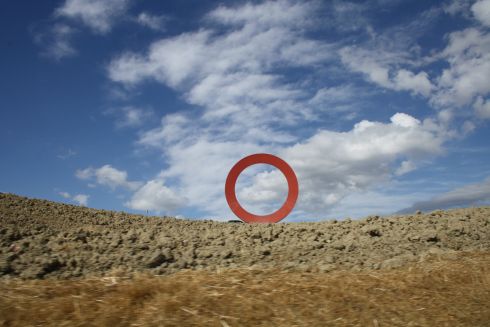
It’s on a hairpin bend as you drive west on the R 68 towards the outcrop of alum and alabaster upon which the town of Volterra sits.  The photo was taken from a moving car – a hairpin bend is after all not a point on the road which invites you to get out and set up your tripod – and much to my surprise, it’s come out almost perfectly (the roof of another car on the other side of the bend being the chief blemish).

A little bit of search engineering tells me that it’s Anello (Ring) by local born sculptor Mauro Staccioli, and just one of a number of pieces placed in the landscape three years ago.  It certainly beat seeing yet more of Anthony Gormley’s remorselessly advancing and rusting iron men in San Gimignano.

The landscape surrounding Volterra seems pale and a little eerie; Tuscan greens and golds blanched till they begin to resemble a moonscape in the white light of the afternoon sun.  That only adds to my feeling that Volterra would make a great name for an alien planet and species.  I imagine Volterrans being a flight of humans originally from earth, exiled millennia ago and evolving according to the terrain and the gaseous nature of the planet that they settled on.  Now they are ready to take back what’s theirs from the evil genius’ metal zombie master race currently presiding over earth.  We can only hope they are victorious.


2 Comments

Great glass elevator

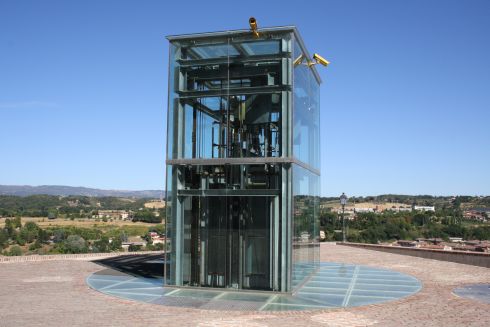
Colle di Val d’Elsa is a rather prolix name for a town, don’t you think?  And it turns out to be a somewhat elongated place too, being split into new town and old, the latter high above the new on a long, narrow peninsula of hill.  On the map we were given was marked a lift – ascensore – obviously for the purposes of getting up to the old town.  So we went looking for it and found instead only a steep incline folding back on itself as paths or roads tend to do when they ascend hills, and began to suspect ourselves the subject of a tourist-oriented joke.  It was only when we got to the top of the hill that we found it, landed like Charlie’s great glass elevator at the centre of a viewing platform looking down on the new town.  It seemed obvious to take a trip back down to find out where the lift came out, and how we had missed it.  So we did, and it was the strangest journey by lift I’ve ever taken; you go from bright sunlight to subterranean gloom, emerging at the bottom into a caved-out tunnel in rock, as cool temperature-wise as it had been hot in the open air.  The street entrance was unobtrusive, but the real reason we missed it was because there were two lift icons on the map, down below and up above, and – guilty of thinking that a map has three dimensions rather than two – I had guided us towards the up above icon without noticing the down below.  Fortunately I was quickly forgiven by the members of my party, on account of how truly peculiar the lift is.  Not to mention how sleekly cool, how other.

The old town was worth the climb, and the expense of the recent installation of the lift.  Two or three parallel streets run the length of the narrow hill, past churches, crypts, and crumbling palazzos; through shaded squares in which to sit, drink and gaze down from the hill or at the people passing through.  The founders of these old Etruscan towns chose their hills wisely and later inhabitants fortified them well; but I bet even then they wished there was a quicker way up and down them than by foot or horse power.  Well, now there is.


Leave a comment

In detestation of a barbarous Murder

A3

Former path of the A3 at Hindhead between London and Portsmouth.

The sailor's stone

The Sailor’s stone, with the former path of the A3 visible to its right.

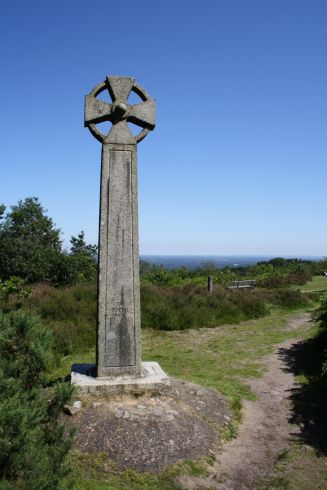
Celtic cross

The Celtic cross on Gibbet Hill.  From here on a clear day it is possible to see major London landmarks approximately 40 miles away.

Temple of the four winds

Plinth of the Temple of the Four Winds.


2 Comments

Asylums

London plane

I have to go back to the old place first.  I left some confidential items in a locked draw on the last day but one, then managed to forget to bring in the key to the draw on the final day.  If the pedestal is moved, I’ll have to declare their loss, and all sorts of shit will ensue.  So on what is supposed to be day one in the new office, I go first to the old place to retrieve the documents, among them a thick and damning report about a local institution which never saw the light of day at the time it was put together.  That is, having had sight of its contents, the institution was powerful enough to ensure the report’s suppression.

The old office is the Mary Celeste.  It has the feel of being recently deserted, but not asset-stripped.  The lights are out and the humanising touches are gone.  The place has history; we were just a moment in it.  This solidly-built Victorian construction was once the city’s asylum.  Occasionally I used to fancy myself incarcerated, but I know there’s no comparison.

I go to another wing, a well-lit and better carpeted one, to seek out the old place’s legal eagle and show him what I’ve got, in the hope he’ll take it off my hands.  Jon sighs mock-wearily, and says with a breaking smile, ‘Oh, give it to the Echo.’  I make as if to hit him over the head with it.  But as I thought, and even though he has not seen it until this moment, he is happy to lock it in a safe place where it can quietly gather dust.  We say goodbye, and shake hands, wishing each other well.

I drive into the centre.  The new building is shockingly nondescript for one positioned at the heart of the city, and it isn’t any better on the inside.  Decked out in three shades of institutional green, with heavy dark brown doors leading off it, the stairwell depresses me beyond reason.  But I’ve been lucky with the desk allocated to me.  Looking out of and away from this grim building lining two sides of the square improves its aspect considerably; from this angle it is dominated by the Greek Revivalist mass of the old town hall.  I’m perched level with its frieze, watching pigeons wheel.  On the horizon I can see far-off hills, and beneath me the square’s bare-branched plane trees.  It’s a big window, a panorama of sky and stone with people constantly moving over the floor of the square.  In this corner I am somewhat distant from my colleagues, who I sense are also trying to overcome their initial feelings of dissociation as they unpack and arrange their new desks so that they resemble the ones they’ve left behind.  I feel an odd mixture of nerviness and dreaminess; the former at being among new faces as well as old, the latter in having such a distracting view.  I try to settle myself by writing something, by writing this.  The chimes of the town hall’s clock measure out the quarter hours.  There will be no escaping the slow flow of time here.

But then it’s not like I haven’t been here before, or somewhere very like it.

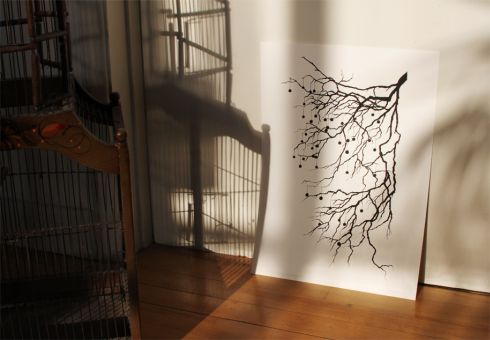
Photo of birdcage and ‘London plane on Hampstead Heath’ by Michael Goldrei via microsketchbook.


6 Comments

Everybody’s game

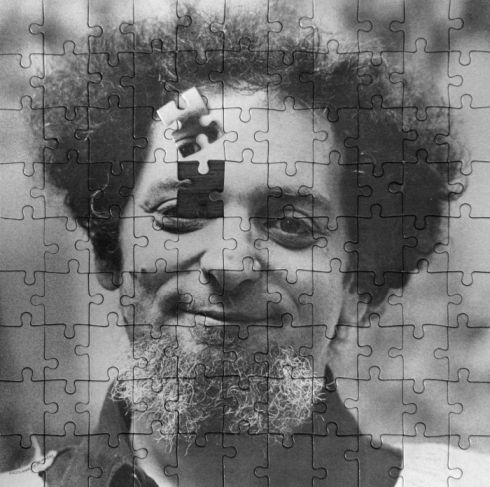
[The subject is everybody’s game.]  The game of words.  Because it is.  A game you play with others or against yourself, pitting your wits against language; one individual versus all who have shaped its regional form over the millennia.  And so every day I sit down to manouevre my editorial hoover around the stylistic louvres of my virtual oeuvre, chopping and changing and inverting the shape of sentences, avoiding repetition and hesitation but taking some considerable delight in deviation, and often borrowing as shamelessly as English does, as Georges Perec did.  I twist and twirl the nouns and pronouns and adjectives and verbs and adverbs and prepositions and conjunctions and interjections that have escaped the mouths and minds of others into sequences of words that only this random Shakespearean monkey could have put into precisely this order, with this particular intent, at this very moment in time.  [The buzzer sounds for ‘this’.]

Whether it goes onto be read or not is almost beside the point, although there is in me still some small obeisance to the Duke of Wellington’s injunction about the intentions of his mistress Harriette Wilson – ‘publish and be damned’ – to see whether the words I game into being having any kind of shared meaning, whether like a ball of soapy effervescence in a hot bath, they diffuse pleasure in the mind of a reader, perhaps even explode there, the pink flash of potassium coming into contact with the very same liquid.

And here we are, like 18th century pamphleteers, only with our knives and teeth largely blunted, pouring forth reams of words from electronic presses, trying to forge connections and kinship and perhaps even enlarged understandings of what it is to have language at our disposal; what it is to be human.  This silent lithography makes so much noise, but in among, there are words that speak to us, sentences that make us laugh or think, and paragraphs that reveal both ourselves and the lives and minds of others to us.  [The buzzer sounds for ‘that’.]

The game of words is a game which everybody can play; because of the internet, at times it can seem as though everybody does.  Yet online or off, in pubs and cafés and marketplaces and offices and stations and temples and hospitals, isn’t everybody in their enormously varied lives upon this planet regularly or at least at one time or another struck with amusement and perhaps even awe at the peculiarities and potential of words and how they can be strung together?  It may be a luxury to many, and you can’t even say that it is one which comes without a cost attached, but this modern day issuer of broadsides thinks we should all in our ways try to play it every day.  Because at its best, it is a game in which everybody wins.  [The buzzer sounds for ‘which’, but the whistle blows before the challenge can be made.]

Puzzled image of Georges Perec via Arte Mosaico Ravenna.


1 Comment

I am still a tree

Scots pine

The scots pine with which I’ve been foolish enough to identify myself has survived the latest threat to it.  According to the council officer’s inspection report, its felling ‘would represent a significant loss of amenity to the locality’.  If you are a public servant writing to residents, I guess you can’t say that you’re granting a tree a reprieve because it’s beautiful, and a symbol of all that’s good in the world.  However, its two shorter neighbours have not been so fortunate.  Since they had only ‘limited general amenity value’ and were also reckoned to be a ‘potential hazard’, the week before last they were chopped down.

It seems to me that they were condemned more for not growing straight and true than for safety reasons.  But I liked how they were; they leant into each other like lovers (there I go again, anthropomorphising furiously).  Although perhaps it would be more accurate to say that one was seeking to avoid the kiss the other was leaning in to give.  Or maybe they were simply two old folk joined at the hip, bending their heads into the prevailing south-westerlies, and holding onto their hats.

The owner of the neighbouring property (now known as ‘tree-murderer!’ round these parts) will not be liking the fact that he has to plant one new tree of similar standing to replace the two he has been able to axe.  It’s a classic piece of quid pro quo political compromise on the local council’s part, dressed up with shaky and partisan evidence about safety, and it leaves no-one entirely happy.  But I couldn’t quite muster the energy to campaign for the preservation of the two condemned trees; thinking that if I did, it might ultimately tell against me and ‘my’ tree the next time it comes under threat, as it surely will.  So I guess I quid pro quo’d too.  Perhaps I should have more faith in the administration of local planning process, but I don’t.

In the end the most important thing is that I am still a tree.


4 Comments

Stepping out of character

Naturally, I assumed that as the book progressed, this plan would change, because books always end up taking on a life of their own, and because a person doesn’t write about what he wants to write about but what he’s capable of writing about.  I also assumed that, although everything I’d found out about Sánchez Mazas over time was going to form the nucleus of my book, which would allow me to feel secure, a moment would arrive when I’d have to dispense with those training wheels, because – if what he writes about is going to have real interest – a writer never writes about what he knows, but precisely about what he does not know. – Javier Cercas, Soldiers of Salamis

I often used to feel the same disgruntlement as Arthur Seaton.  ‘Whatever people say I am, that’s what I’m not.’  But at the same time I always knew that such contrariness ultimately ties its speaker or believer in knots; it certainly locked me into as inescapable a conundrum as the kindred contradiction of having once aligned myself so fervently with the song ‘I’m not like everybody else’.

Recently here I have been stepping out of character, because the alien found he wanted to be human, at least for a time.  But even as I have been doing so, I’ve felt the contrary pull: the human wants to go back to being a bloody-minded alien.  You’d think it might be different after all these years on earth, but it’s still the same.  Only now it’s getting confusing.  If I step out of the character of the human pretending to be an alien, only to assume another, that of the human-pretending-to-be-an-alien-become-human-again, then am I in character or out of it?

Like Midas’ fingers turned all he touched to gold (though perhaps without such dire consequences), I transform so much of what I see and feel into words.  I don’t think I can help it any more than he could, though often I wonder whether I have the means of expression to describe the places – mental and physical – in which I find myself.  I suppose that has always informed my writing, been the impulse for it, the not knowing rather than the knowing.  Needing to use words to work out what I think and feel beyond what I (think I) know I think and feel; to translate the peripheries of thought and the edges of emotion into language.  But however pioneering this settling of wild interior landscape may seem to me, sometimes simple expression is not enough.  There are times when I can’t find the words I need to fix myself, to find rest or peace, but need to, to scratch a particularly persistent itch, to stop myself falling down a deep black hole.  To keep myself away from those holes, if not the itches.

And so I have been wondering again, do I have to stop making sense to start making it, like Ben Marcus in The age of wire and string and thousands of bloggers with elliptical tendencies since?  I’ve never been inclined to think so, and I’m still not sure I do, but more than occasionally I feel the need to try.  To rap my fingers against my skull and start in on breaking up coherence, the long-established patterns of thought, and find what if anything is underneath.  Stir the sediment into a muddy maelstrom, record its chaos, watch how it settles, reflect on it.  Quantify and qualify the changes, if any.  I find I want to do that much more deliberately, with less concern for shareable clarity, and more for the suggestive power of language.

Well, I think I want to, anyway.  I may change my mind tomorrow.  And whatever people say I am, that’s probably what I was, yesterday.

Still from Saturday night and Sunday morning via not _ going.