
1. To more easily imagine that you are a character in Bleak House.
2. As winter warmers.
3. Come spring, they go very well with Fred Perrys.
4. As a late-blooming rite of passage, just when you think there are none left.
5. To save time shaving.
6. To diminish the size of ears.
7. To give the impression when wearing a woolly hat of having lots of hair underneath it.
8. To look out of time.
9. To have friends ask, ‘what’s with the lamb chops?’
10. To remind yourself in future years how much better it is not to sport sideburns.
Plastic henge
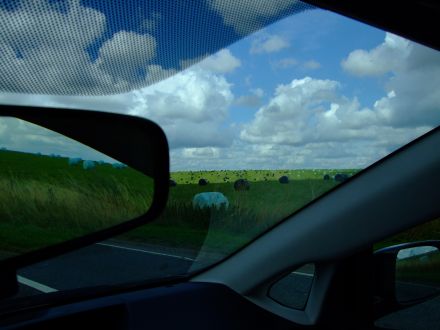
Wiltshire, 2009.

Kerplunk! – [The island]

You stare at the maps of home in the back of your diary, spending hours tracing the path of your life, circling out from a point on the fringe of the capital to a succession of dots within a fine web of country lanes on the flats of Suffolk, then plunging back into the heart of the City, shooting off like a cardiograph stimulated by palpitations for weeks and weekenders away. Plymouth, Nottingham, Exeter, Leeds and Brighton – all become connected – England as far apart as Amble and Penzance. You imagine some watcher over humanity tracing your whereabouts and movements on a large scale map, recording the circles and strange turnings and goings-back-on-yourself that you make during the course of a week or a year. You wish that your paths were as undeviating as those of aircraft lines across the globe, that the watcher over humanity might give you a few hints as to where you should be going.
Such a spirograph would also chart the M1 and M6 hitch into Strathclyde, the first leg of an eight day figure of 8. From the mileage chart in the diary you work out you fell just short of four hundred miles for the day. When you reached the club that night, in a little west coast town jutting out like a nose into the sea, you and your friend manage to clear the dance floor simply by taking to it, wild and unrestrained, misshapen, round pegs trying to fit into a square hole.
You travel between the twin sentries guarding the Highlands, Glasgow and Edinburgh, where, on a freezing morning, you kiss another friend goodbye, walk out of town and drop down to Stoke. There, with a feverish headache from want of warmth and food, you watch an early performance by the friends who are soon to come France, in the back room of the Gorgon’s Head. It is one of those seemingly carefree but charged early displays of their melodic manifesto, out of which they later gained recognition, and inevitably is witnessed by only a few people; the early days of a group when spontaneity comes more easily and self-belief pugnaciously, and it is freshness rather than success which inspires. Whether it’s the music or the spirits or an unsuspected reserve of energy, you don’t know, but your headache disperses.
Reaching Bristol the next day is easy, with your lift, a student farmer in a Morris Minor, taking you right into the city and over the antiquated, single lane, one way, roller coaster flyover. Touching down, you feed a score of swans with a left-over roll, in what you will later learn to call the Floating Harbour. Your trio of friends receive you enthusiastically in the city they’d set out to conquer, grateful for the impetus a visitor provides in the black hole of dole-time.
And so back to London, on a hitching high; with your City-mask not quite fully resumed, the tube journey home is taken in rare exuberance and a feeling of being above the City, impervious to its constraints and its customarily grim set. Once you are reassimilated, only weekend alcohol lets you laugh in the stony face of the weekly cycle of imprisonment which is the bargain London forces on you.
There is also an Underground map at the back of your little black book, around which you can catch remembered trains. On this graph within a graph, you chart hundreds of journeys into the centre with Louise, and hundreds more elsewhere and without her. You even have an enlargement of the West End and the City, to re-enact the dramas of couriering, exploration and drinking, in a spirograph of celebration and misery.
A wild slim alien
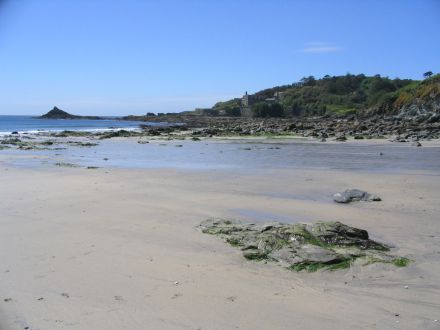
Cornwall, 2007.
The Stone Dance
I found their respective stories on Chan’s laptop, and as time has allowed, I have been posting them here, to general disinterest. But they were owed a lasting memorial, whether they are dead or living happily on another planet and raising Apsara Suloch so that one day the first human-badezoid will fly across the quartz fields of a planet on which she was not born. And perhaps one day she or Chan will return to tell her story. Their story.
It is only now, on writing this, that I’ve become aware of the legend of Dawn’s men – Dans Meyn, the Stone Dance – of the two pipers who played for nineteen merry maidens one Saturday night in a field near Lamorna Cove. When the bell of the nearby church struck midnight, too late the pipers realised that they had dared play on into the Sabbath. They dropped their instruments and ran, but only got so far before each was petrified. The nineteen maidens danced on, without music, hearing its echo in their heads, and in doing so their fate was also sealed, for they too were turned to stone, as they formed a perfect, merry circle, and now they stand that way for all time.
But it’s a cautionary tale, told by the Christian church to scare the pagan leanings out of its flock. I like to think the Badezons chose the place for the wild slim alien’s and Chan’s merry, celestial maiden, Apsara Suloch.
*
One day, not so long ago, a photo appeared on my laptop, as an email attachment. There was no clear sender, just a string of hieroglyphs which had somehow resolved themselves into something which made sense to the paths of the internet down which this image was obliged to pass to reach me. Possibly unwisely, I clicked in lazy haste on what was obviously the icon, and there it was.
The selfsame quill pen I had given Chan on her twenty-third birthday, a ticklish joke of a present from long ago, now returned to me as a three-dimensional hologram, its barbs and barbules rendered in astonishing detail, detail projected across the universe to our planet from one far, far away.
The wink
It was an ordinary piece of space hardware, not unlike the kind that have come out of the collective imaginations of those sci-fi movie making departments which tend towards the realist rather than the fantastical. How it was not noticed by the government agencies that watch for such things I do not know. Perhaps it was, and they kept it secret, because there was no contact, no interaction, nothing to say except that the aliens, if aliens they were, got away. Oops.
Cornwall saved the three of them. Had the hospital been closer to London, the decision makers and captive-takers would have been on the scene the day after the night of the birth rather than the one following. Weeks afterwards, when I returned to Chan’s house, it had been turned over. It would however have been searched in vain, because all that was particular or precious to Chan had been moved to the safe house, anticipating the possibility that she would need to be hospitalised. Before the birth gave us all proof, it was she who believed the alien’s story sufficiently not to leave the matter to chance. And so when the special agents got to her house, there was nothing left that would help them, except perhaps the DNA forensic operatives might extract from skin fragments and the like. But I doubt they’ll be growing their own winged Badezoid any time soon.
The night they departed, I was having trouble sleeping. In fact every night in the safe house, I had lain awake long into the early hours, thoughts speeding and swooping through my head like a murmuration of starlings. At Chan’s there had at least been the noise of the wind and sea to stand in for the hum of city traffic, but here in this old farmstead cupped in its own valley, there was no sound at all until the birds began their chorus, which was when at last I would fall asleep.
Deep in the night, I heard some combination of the three of them moving about, but that was not unusual, with a hungry, short-sleeping baby. So I took no notice of the different pattern of noise, thinking only that they were having a harder time than usual getting Apsara to settle. I nearly got up, to help, as I had done on most other evenings, since I was not sleeping, and so as to allow Chan a precious hour or two herself. But I felt especially tired that night, and something bade me stay in bed. I fell into a half sleep, with my bedside light on. I woke from a dream in which I had heard a door open and close, and wondered who had passed through it. I looked from the window, in this dream, and I saw Chan waving, and Apsara following suit, only using now full-grown wings to do so. I snapped awake. I could hear nothing, nothing except the ticking of the alarm clock and my anxious heart beating. I kicked off the covers and went out on the landing, peaking in at the door of their room. They weren’t inside. I knew from the feel of the air in the house that I would not find them downstairs either.
There was a note propped against the tea caddy in the kitchen.
‘Dearest Rupa,
The alien has been contacted, with something like the smuggler’s wink. His people want to take him back. They have told him that he agreed to the loss of his wings, and that there is proof of that. They say he will return as a heroic explorer. He’s nervous, but he wants us all to go. He thinks we’ll be ok, despite all the black dreams of the past. I hope he’s right. Well, it could be no worse than what would happen here. And the pull of another planet, of taking Apsara Suloch to the place where her wings belong, the place from which they came, well, it’s hard to deny that pull.
We leave from the Merry Maidens, near Lamorna, half an hour before dawn. Forgive me for not waking you, for leaving without a face-to-face explanation. I didn’t want you to feel you had any part in the decision I have taken. Even if you had said nothing, I’d have spotted the caution in your reaction, however heavily you disguised it, as you would have done, you being you. I needed to be free to make my own mind up to leave Earth, even though I may simply end up exchanging one prison for another.
I will never be able to thank you enough for all that you did for us all. The first interplanetary doula! If there is any way of sending word, I will send it, to let you know that we are safe and well. And when I do, if only a sign is possible, think of the first present you ever gave me.’
As I read, I realised that the cushion on the chair on which I sat had a residue of warmth. Chan had not long been sitting here herself writing this note. As soon as I got to her name and the kisses at the bottom of the note, I leapt into my car, checked the map, and drove. I drove like a woman possessed, not quite sure of my intention, and in my panic, unable to formulate one on the way.
I arrived just before dawn, and saw something immediately and obviously alien beyond the hedge. I threw up dust in the lay-by as I screeched to a halt. I sprang from the car in time to see a small, light brown rhomboidal craft with winged insignia not unlike a laurel wreath had landed within the perimeter marked by the nineteen stones of the circle. Its angles were blade-like, its substance dense and matt and light-repelling. Almost at once the ship lifted into the air. It made less noise than you might suppose, though certainly more than a military fighter, and the grass was streaked flat with the force. I wanted to run towards the stones but the sound made me step back. The ship began to move through the sky at an angle beyond the capability of any human craft. Then it very quickly faded to a mere speck. There was no moment where you could say it had definitely gone. I kept on looking, long after I knew that all I was seeing were stars.
The lugger
Through the pain and the pain relief, through the half-heard urgent discussions at my bedside, through the drifting in and out of consciousness while the baby – my baby – slept alongside me, there were two conflicting moods. First, the euphoria, the joy, the sheer woosh of having at last brought a life into the world, of immediately loving the creature, her initial wide-eyed, bamboozled alertness, her uniqueness as an individual life form regardless of the derivation of her genes. She was light but she was solid, her presence the strongest reality in my dreamlike state, a connection to the world which was both the balm of love and the alarm of fear. I could be soothed and lulled, or stung and poised at any moment for fight or flight, even in the midst of this exhaustion. Fear was the keynote of the second mood. We had necessarily put ourselves into the system, and with the proof of the alien’s story now before me – her beautiful little oriels and oversize shoulders, the unusually wide spacing between her eyes which seemed in itself conclusively other – it was obvious that the system could only be equated with captivity. I knew instinctively that I would give myself any amount of pain and force myself to override it, if that was what it took to get my daughter to a place of safety. A place where she would not be held up and scrutinised as a miracle, but regarded simply as a child to be loved and nurtured. I trusted the alien and Rupa to find a way out. I knew they would not let me down, but at the same time I realised we would have only the one chance. If anything went wrong, we would find ourselves under lock and key and lives under a high security regime would await us all. For our own protection, they would say.
But why did the alien let the consultant take photos of me, and our baby? I was too drained to protest. I hoped they knew what they were doing. When the alien whispered in my ear that they were playing Gareth into the team, because it might result in him giving us greater protection, I was relieved. And when the following morning brought a visitation, the strategy proved its worth.
‘I’m sorry,’ said our protector, ‘but I must insist you leave. This was a particularly unusual birth and mum is understandably tired, and in no way up to receiving visits from the chief executive and half of his office.’ He ushered the disgruntled man and the suits flanking him back into the corridor. The baby was swaddled, so the bigwigs did not get a peep at her upper body, but that only meant that there was now another danger – that having been thwarted, they might seek advice from London. It would be a convoluted chain, but it would not take long before people considerably more forceful than those who had just tried to enter the room started appearing at our door. And Gareth would be powerless to prevent their entry. We just had to hope that Cornwall’s distance from the centre of government and intelligence might buy us some time, even if only a day.
The consultant was obliged to attend to other births and patients, and we were left alone. The implications of the chief executive’s visit had not escaped the alien or Rupa.
‘We need to go tonight. I’ll call Sandy. Rupa, can you acquire whatever meds are necessary?’ Rupa nodded. ‘Chan, do you think you could stand, and see how it feels to walk up and down the corridor? That way if anyone sees you tonight, they’ll be more inclined to think you’re exercising.’
The rest of the day passed in a state of heightened tension. Gareth reappeared at intervals, talking with the alien, about what he remembered of Badezoid reproduction and birth, and with me about how the pregnancy had been, its unusual length and features. He even purported to show understanding as to why we had tried not to involve the health service in the baby’s delivery, though he said we had run an absurdly high risk in doing so. He had obviously convinced himself that he was being told the truth. We tried to appear relaxed, proud parents who now saw that involving a benevolent, caring health system was nothing more than reassuring.
Fortunately Gareth had himself a home life to which even he must return, and as evening began we were left alone with only the odd passing midwife for company.
At one point in that long night of waiting Rupa asked,
‘What are you going to call her?’
‘I don’t know. None of the names I ever had in mind before seem right now. Have you thought of anything?’
‘I have thought of something, yes, an Indian name. Apsara. It means ‘celestial maiden’.
‘And I have remembered something too,’ said the alien, nodding at Rupa’s suggestion. ‘I think it might even have been my grandmother’s name. Suloch. One with beautiful eyes.’
‘Apsara Suloch. Yes. How do you like your name, Apsara Suloch?’ The baby wriggled her elbows, as if anticipating the expressive extension of her wings. Of course, it might have been in response to the tickle I gave her chin.
We made our escape at three in the morning. Rupa held Apsara, and the alien helped me, going ahead at times to check that our way was clear. Only once did we have to duck into a hiding place before reaching the exit. A dirty white van stood alone in the visitor’s car park. Sandy stood ready by its back doors. He greeted us with a smile, and opened them.
‘It’s what in smuggling terms you might call a lugger,’ said Sandy.
We ran for our dear lives, as a lugger might have, across the Channel, pursued by the King’s cutters. The sound of a siren cut through the night, above the growl of the van, piercing us all. But then the ambulance passed us at speed, heading for A&E, and the tension drained away.
The fugue state
It was when I put an exultant fist through one of the ceiling tiles in the room to which Chan and the baby had been transferred that the consultant told me to calm down. But he was barely calm himself, because he could see what I could see – that this was no ordinary human baby. The upper third of her musculoskeletal structure had significant differences to those other babies down the corridor on the maternity ward. Her shoulders were oversize, where in a human baby only the head is. Following the two scalloped protuberances down the baby’s back with an informed pair of hands, the consultant’s face showed constant surprise. Gareth’s professional coolness in the operating theatre in the operating theatre had been replaced by rising excitement that he had just delivered into the world an extremely unusual infant – possibly an impossible one.
Chan held the baby’s head to her cheek, kissed the covering of still wet hair, ran her fingers over her daughter’s wing stumps, all the while murmuring to her, while Rupa and I sized up Gareth, wondering whether we could trust him, whether we had now moved so far beyond trust now that we would need to do something decisive if we were not all to be turned into lab rats. – That was the phrase Chan had used, in fear of just this eventuality. Rupa nodded at me, confirming my own impression that Gareth’s elation was mostly down to the scientific wonder before him rather than contemplation of the prospective fame awaiting him. But inevitably those thoughts would soon run through his head. How would they fare against his duty to do what was best for those in his care? How quickly would decisions be taken out of his hands as word spread? How far would word spread, and how quickly?
Rupa took me to one side. ‘I think you have no option but to take him into your confidence. He may have enough clout to protect you all long enough for us to work out what to do.’
‘If he feels we trust him, he may trust us.’
‘Exactly.’
So I told Gareth that I needed to talk to him. Rupa stayed with Chan while I trailed the consultant to his office.
‘So, are you’re going to enlighten me as to how you believe your baby came by those strange shoulder formations?’
I told him everything, from the day Chan found me on the beach to the moment we presented ourselves in A&E. I told him about life on Badezon, and the fate I thought had befallen me. I asked him to consider my unnatural hang-gliding ability, though of course he only had my word for it. I took of my t-shirt and showed him the traces of the scars at my shoulders, where my own protuberances had been severed. Almost everything. I may have left out the part about me having come unhinged from time to time, enough to wave a knife in the faces of Chan’s innocent neighbours.
‘You’re an alien. From… Badezon?’ He couldn’t quite bring himself to believe it. ‘Have you heard of the fugue state? Retrograde amnesia? Haven’t you – not to put too fine a point on it – simply been acting out a form of ingrained psychological role play?’
‘So how do you explain my daughter’s oriels?’
‘Oriels?’
‘That’s what we call them – the shoulder protuberances. From which her wings will sprout.’
‘The wings you no longer have.’ I shrugged, and watched him mentally scroll through the possibilities, discarding each in turn. He knew none of them explained what he had felt under the newborn baby’s skin, and was sharp enough not to bluster me with the least outlandish of the explanations.
‘You must admit it’s a lot to ask me to credit. And that there are holes in your story, giant holes – you will say because of the amnesia, of course, I understand that. And yet… that exoskeletal formation at the shoulders; nothing else explains those except a genetic lineage not of this world.’ A little dazed by all he had seen and heard, he held his jaw in his hand, and I knew he was trying to think clearly and work out what to do next. I felt it might be best if I didn’t give him the opportunity to do so. I had noticed the camera on his desk.
‘Bring that. You should have documentary evidence. On the condition that you do nothing with it without our say-so.’ He looked in a draw, and eventually fished out a sheet of paper. Some kind of waiver.
‘No, I won’t sign that, not yet.’
I was dangling him the celebrity, if he wanted it, or merely the scientific kudos. Of course, if we disappeared off the face of the planet, it could turn out to be ridicule. I just hoped that he was unaware of any protocol within the hospital to deal specifically with any situation as unique as this. If we passed into government or military hands I feared for our futures.
As Gareth took photographs of baby and mother, Rupa and I stepped aside again.
‘How quickly will Chan be able to be back on her feet?’
‘Three or four days, if there are no complications. She’ll be able to move about – she should do so – but she’ll also need lots of rest.’
‘Rupa, nevertheless I think we are going to have to disappear. Otherwise our lives will no longer be our own. I don’t want our child to grow up in what would essentially be captivity.’
We had foreseen that the need might arise. We could not now go back to Chan’s. But Sandy, who rented out the odd property, had readily agreed to prompt a friend who was also in that line to set aside a safe house for us. It would buy us some more time. Not much, but enough to work out what to do next. But a lot could happen in the three days she was supposed to remain in hospital.
We would need to plan for a sudden discharge.
Appearance, Pulse, Grimace, Activity, Respiration
I remember thinking – joking to myself through the agony – careful, gentlemen, I’m in labour and severe pain here, as the paramedics transported me towards and into the back of the ambulance. I remember thinking: I hope this story, this tale of the alien and me, does not begin and end with an ambulance. These weren’t the same men who responded to my 999 call, the day I found him, the day I found a wild slim man on the beach apparently suffering from amnesia. Then my thoughts were interrupted, as one of the new pair of paramedics clamped a mask over my mouth and breathing became suddenly easier, for a while. I drifted off on the flow of gas, and when I came back it was with a bump onto a stretcher, the feel of night air, and the electronic slithering sound of A&E doors.
The on-call obstetrician arrived moments after I did. He told me his name, what he was about to do, and not to worry, because I was in good hands. He was awful sure of himself, but, making an effort to focus on his words, his demeanour, the grey curls of hair above his ears, I decided to trust him.
‘Up to theatre straight away, I think.’
It seemed I was flying business class today. But I needed everything to slow down, to slow these moments down. I put up a hand, and the consultant signalled the porters to stop.
‘You may find that there is something… unusual about this baby.’
‘Unusual? How d’you mean?’
‘It may be… anatomically different.’
‘Something hereditary?’
I thought that this was perhaps enough of a steer, so I nodded.
‘What exactly?’
‘I can’t – I can’t tell you that.’
He looked at me, penetrating grey eyes, the same colour as his curls.
‘May I?’ He felt again. At one point a flicker of not knowing passed across his face, but he moved his hands onwards and erased his surprise.
‘It’s certainly a big baby; bigger than I would have expected, from the look of you.’ He paused for eminently humorous effect. ‘Though possibly not you, dad.’ The slim alien loomed, across from the doctor, above him, above us all, a look of wild anxiety etched into his normally impassive face. ‘But that only emphasises the need to take this one out via the tummy, so that’s what we’re going to do. Dad, come with me and we’ll get someone to fetch you the necessary, assuming you would like to be present?’
The alien nodded, as if silenced by the new environment he found himself in. He clutched at my hand and squeezed. I did not want him to let go. I was scared at the thought of being cut open, and by fearful imaginings of what would be brought forth. This wasn’t what was supposed to happen. Not what was supposed to happen at all. I thought of my trusted doula.
‘Where’s Rupa?’
‘I’m here Chan,’ she said, from somewhere beyond the foot of the bed. ‘The doctor will take care of you now.’ She said it, I knew, to give me confidence in him, if I had not found it myself. It meant, I believed, that she trusted him too. I relaxed my head, let go of the alien’s hand, and the bed was set in motion again.
The lights were bright, too bright, even though they were angled away from my face. I wanted the alien to stand where he could shield me, a shaggy-haired sun umbrella. The local anaesthetic was administered, and soon I felt that my head was somehow disconnected from my lower limbs. The alien watched somewhat aghast as they cut me open, but I pulled him back to me, letting him know with my eyes that I wanted his, until the baby was raised up high.
Not everyone spotted them at first, but the consultant knew, as he held the baby, as the umbilical was cut, and the mouth of my baby opened for the first time to emit what sounded like the typical crying of a human infant. He played it cool.
‘You have a girl, Ms Charlenny. But you were not wrong. There is a very usual formation of the scapulae here. Helen, what do you say?’ He passed the baby to the waiting paediatrician, who took the baby a distance away to pronounce the Apgar score. I released the wild slim alien’s hand so that he would follow.
‘Chan, she’s beautiful,’ he shouted, from the other side of the theatre. She sounded beautiful. I couldn’t hear the paediatrician’s reply to the obstetrician’s question; it was lost in the shouting and the crying. Give me my damn baby, I thought. And then there she was, pink and hairy-headed, cheesy and bloody against my breast, impossibly beautiful, and no less so because of the two scalloped protuberances on each of her outsize shoulders.
Confinement
I came in from my shift at Sandy’s less tired than usual. I had done very little flying of late. I knew Chan would not want me to be far out to sea when the time came. Quietly I went upstairs to see if she was sleeping. She wasn’t. In fact, unusually, she was lying against the side of the bed rather than on top of it. Her face was pale and drawn, and her voice when she found it was urgent.
‘I think it’s started… call Rupa.’ There was an edge in her voice that felt like a reprimand, for me not having been close by at the moment when she needed me to be. But it was probably just the painful peak of a contraction that made it come out so. ‘Now,’ she said, and that was a reprimand. I went across the landing and knocked. After a few moments Rupa appeared, in t-shirt and pyjama bottoms. She reeled off the list of things I was to fetch, which would not be difficult because we had set them aside weeks ago; Chan was way past ten months now. Rupa felt sure that she must have her dates wrong, but she and I were both sure that she had them right. She was overdue beyond the record books. The cross-breeding had to have resulted in a longer gestation period – not that I could remember precisely what that was for Badezoids, and so work out an average – but otherwise Chan seemed much as Rupa suggested was normal for an entirely human baby. No cause for concern. Chan wanted to believe her, but never having got this far with a pregnancy, she had no way of knowing whether or not her body was feeling as it was supposed to feel.
But when Rupa signalled that she and I should both duck out of the bedroom, Chan knew something was up. Rupa was perturbed that the contractions were not proceeding according to the book. ‘The timings are not as they should be; and now she is in more pain than she should be. I don’t feel confident about where this is going.’ We decided on wait and see, but if the level of pain increased, then I would ring for an ambulance. Through an undercover operation she and I had acquired certain painkilling pharmaceuticals, and one of these Rupa now decided to administer. Even though she was in pain, Chan was not pressing us to ring. I think she knew for sure now that what was inside her was not within human understanding, and she was determined that if at all possible her baby would not be treated as a freak. If we could get this new life out of her without medical intervention, that would be worth the risk.
The waiting grew heavy on us. All through the night, and till noon the next day. But I couldn’t leave her side, much as though she might have wanted me too, with Rupa there too, doing a better job of trying to make her as comfortable as she could. It was a hot, heavy morning. From the windows I could see that the sea was a millpond, and even with them wide open to receive such flutters of breeze as there were, the room was too hot. How much hotter for Chan? We gave her ice cubes to suck, and a towel dunked in a basin of ice water was at her forehead. For periods I held her hand; for others she shrugged me off. When such air as there was tickled at my nostrils, I drifted sleepily out of the room, letting myself be carried on my wings by a thermal, out above the sea, where it would be freshest. I hadn’t flown in weeks; I yearned to be out in my natural element, but I also wanted to be here, to do what I could, to carry on holding Chan’s hand through the pain and the effort and the waiting, to see our child, and, yes, I confess, to see whether the body of the brand new life form, covered in vernix caseosa, or its Badezoid equivalent, perhaps some alchemical mix of the two, presented us with proof of my story, with proof that on another planet, bipeds could fly. With proof that I was not mad.
My reverie was broken by Chan’s scream.
Rupa said, ‘Ring for the ambulance. Now.’
 A wild slim alien